

ESVE - Evidence syntheses and trustworthy recommendations
Goal and work plan
The primary goal of ESVE (Evidence Syntheses and Trusted Recommendations) is to build an infrastructure that makes scientific evidence rapidly available in crisis situations. The best possible available evidence on prioritised research questions is to be systematically identified, critically evaluated and summarised - even under the very short timeframes that exist in pandemics or other crises of national scope. To this end, ESVE produces evidence syntheses, among other things, with which research results can be summarised and prepared for decision-makers in the shortest possible time. The evidence base derived from this supports policy-makers, the healthcare system and researchers in making well-founded decisions.
ESVE addresses the following goals:
- Establishment of a coordination structure within ESVE
- Establishment of a network structure of methodological and technical-clinical expertise
- Establishment of a scaling concept
- Establishment of national and international interfaces incl. third-party funding concept
- Testing and implementation of AI approaches
- Validation and utilisation of the structures created
ESVE network
The core of the module is a Germany-wide network of methodological centres and clinical-content expertise hubs, which enables rapid scaling of personnel and expertise for rapid evidence syntheses in crisis situations. With this expertise, it is possible to quickly identify, critically evaluate and process research results globally in a targeted manner - especially under the temporal challenges of pandemics or comparable crisis situations. The network maintains close interfaces with national partner organisations such as the Association of the Scientific Medical Societies in Germany (AWMF) and international partners such as Cochrane, GRADE and the WHO. This ensures a direct link to guideline developments in medicine and health policy decision-making processes.
The network acts as a scalable and centralised platform for evidence syntheses of various types and complexity. This includes, for example, scoping reviews, intervention reviews, prognosis reviews and network meta-analyses (NMA). In addition, the network offers advice on evidence-based study planning, methodological development and training programmes. This is supplemented by the provision of templates, guidelines for action, so-called SOPs, and the creation of evidence syntheses as a basis for clinical studies.
Coordination of the ESVE
The coordination of the ESVE platform will continuously develop the organisational model, manage the members of the network structure, coordinate between the individual locations and maintain an overview of all materials developed and materials to be updated (capacity building, SOPs). The coordinator is also responsible for activating the network partners, recruiting new partners in the event of gaps in expertise and coordinating working methods between locations with content or method-specific expertise. Another main task of coordination is the development of processes for rapid activation and scaling of cross-site evidence synthesis and communication and collaboration with internal NUM partners such as the NUM Coordination Office, NUM infrastructures, FOSAs and external partners such as AWMF, Cochrane, GRADE and WHO. In addition, cross-site interactions such as annual meetings and workshops are organised to ensure a continuous exchange and mutual reporting. The network structure is being established in parallel.
Established ESVE network structure
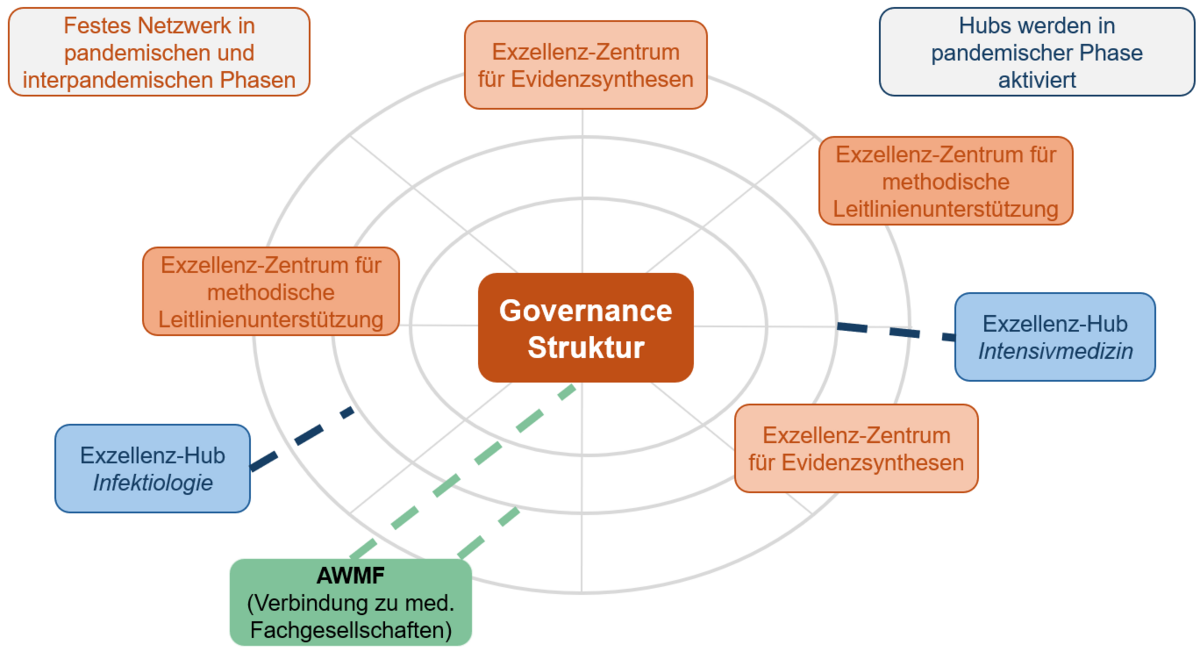
Since evidence syntheses are associated with a standard processing time of several months to a year, sufficient personnel must be available to process them within the shortest possible time. This is achieved through a personnel scaling concept. The supporting element of the ESVE is a Germany-wide, interdisciplinary network of methodological and specialist clinical experts (so-called methodological centres of excellence and specialist clinical hubs of excellence), from which several working groups for the implementation of evidence syntheses and for participation in AWMF medical guidelines emerge in parallel. In addition, a mapping of expertise on specific topics will take place at various locations in order to identify potential gaps and further clinical specialist partners.
The rough structure of the network is shown in the figure. This network is maintained as a living map and is updated each time new locations are added that fulfil defined inclusion criteria or changes are made to the person responsible for each location. The selection of content hubs is to be understood as exemplary and can include AWMF specialist societies, FOSAs of the NUM or other cooperation partners and networks.
A special feature of the ESVE is its experience in the use of mathematical modelling studies in evidence syntheses, which represent a central source of evidence for infection epidemiological questions. Modelling can provide evidence if a research question cannot be answered by primary studies due to its complexity or length of observation and relevant individual data are available for certain populations, long-term follow-up or relevant results. The evaluation of modelling studies must take place within the framework of ESVE, as no established standard exists to date. In addition, the already established cooperation between ESVE and MONID (Modelling Network for Major Infectious Diseases) ensures that modelling expertise can be consulted throughout Germany.