

PAKOP - Pathogen Expertise Platform
The Pathogen Competence Platform (PAKOP) strengthens the research and diagnostics of different virus groups and maintains the ability to recognise and classify new pathogens at an early stage in its laboratory network. PAKOP brings together the collective technical and material capacity of the university virology and microbiology institutes and initiates an immediate technical response in the event of a pandemic (anticipation/expertise, test development, research support).
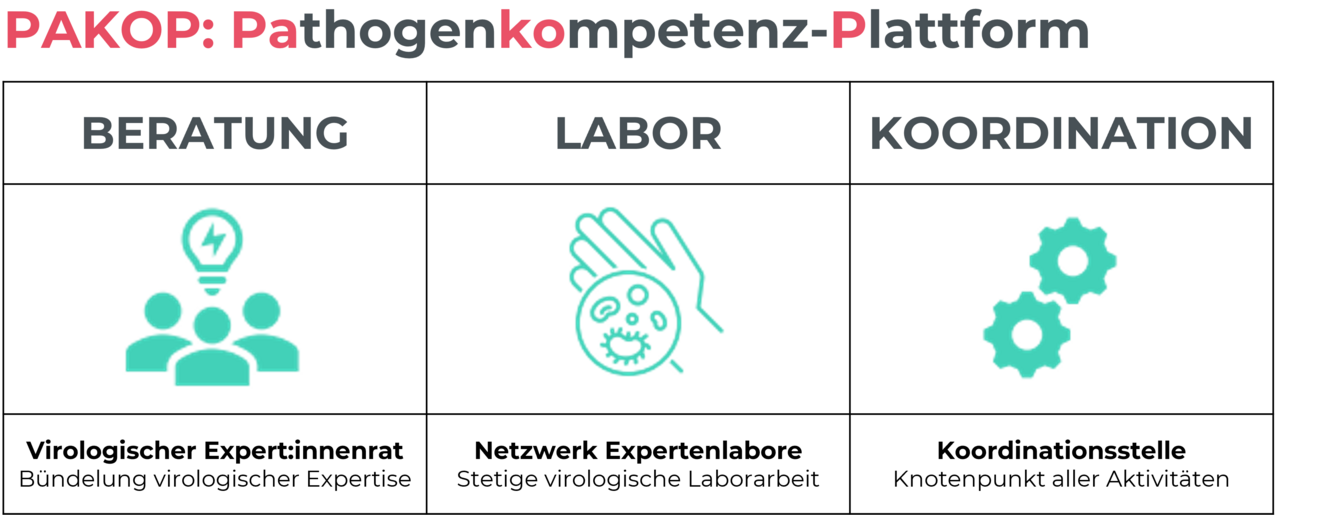
CONSULTING - Virological Expert Council
The Virological Expert Council is made up of representatives from the following areas and bodies: PAKOP coordinator, president and vice president of the GfV, management of a university BSL-4 laboratory and representation of the RKI. In this way, the areas relevant to the work are integrated and duplicate structures can be avoided. The areas of responsibility of the Expert Council include the following:
- Semi-annual meetings are held in which current situation assessments are made on emerging and zoonotic viral pathogens.
- Liaison takes place between the Robert Koch-Institute and the specialist community of academic virology laboratories in the Network University Medicine.
- In the event of a pandemic or outbreak, representatives of the respective National Reference Centre or consiliary laboratory as well as NUM scientists with pathogen-specific expertise are consulted.
LABOR - Network of expert laboratories
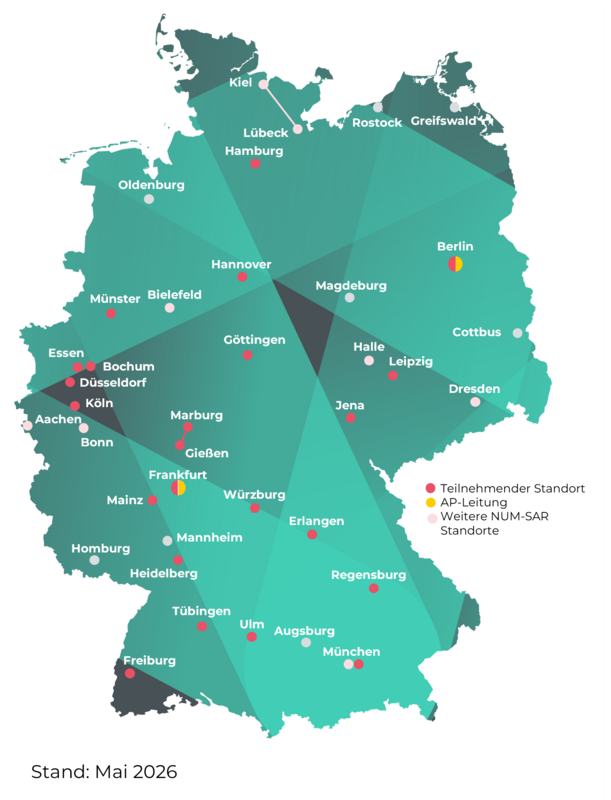
The Expert Laboratories Network brings together 23 university medicine virology laboratories, each of which has a virus-specific specialisation and can contribute to the network. In the event of a pandemic, the network forms the basis for a rapid laboratory diagnostic response and for immediate technical adaptation of standard procedures to new pathogens. The participating laboratories have specific reagents for genome sequencing as well as cell culture methods for pathogen characterisation. They carry out initial immunofluorescence assays, antibody tests and neutralisation tests, which are essential in the first phase of a pandemic. The aim is to make a well-founded initial assessment of key disease characteristics such as virus excretion kinetics, duration of infectivity and antibody formation in order to enable an effective medical and epidemiological response.
Three of the expert laboratories
have a special function in the network:
Berlin - Test Development & Test Implementation
- Early pandemic test development, coordination with expert/reference laboratories, non-infectious control material, implementation EQA
- Early evaluation of diagnostic tests within the network
Frankfurt - Clinical-virological propaedeutics
- Extensive virus platform with currently over 300 virus isolates from 17 different virus families, under quality-assured process. Virus bank is accessible to all expert laboratories via PAKOP.
Hamburg - Test automation
- Establishment of the tests implemented in the network, especially on large PCR devices
COORDINATION
The coordination centre acts as the central contact point for PAKOP. It coordinates the work of the network of expert laboratories and the activities of the virological expert council. In the event of a pandemic, all relevant contacts are known immediately and all communication channels have been tried and tested. The Coordination Office handles and mediates external and internal enquiries, for example from politicians, the public, experts or the Network University Medicine. It also ensures cooperation with external institutions, including the German Center for Infection Research, the Helmholtz Centre for Infection Research, the Robert Koch-Institute and European institutions such as HERA and the ECDC.