

MuSE - Monitoring and Surveillance Unit
The central task of the Monitoring and Surveillance Unit (MuSE) is the early detection of clusters or outbreaks of communicable diseases, new pathogens or clinical pictures as well as regional peculiarities. Infection epidemiology, including the analysis of risk factors, quality monitoring, monitoring of resources and healthcare as well as the utilisation of healthcare are the central fields of activity of MuSE. Monitoring in MuSE is a continuous process that enables the provision of basic data, the early detection of changes and the monitoring of the effects of foreseeable crises (e.g. seasonal waves of infection, heatwaves) and unforeseeable crises (e.g. pandemics) and thus allows the early preparation of evidence-based countermeasures. The data is made available to decision-makers both at local level (e.g. hospital management) and at supra-regional level (e.g. VUD, state and federal governments and the Robert Koch-Institute (RKI)).
The RKI plays a central role in national health monitoring and risk assessment in Germany. MuSE supports this key function by providing supplementary, high-resolution clinical and operational data from university hospitals. This data expands and contextualises existing national surveillance streams, enhances situational awareness, improves analytical depth and enables a more comprehensive and timely assessment of public health threats at the federal level.
MuSE also acts as a sentinel system that collects detailed, standardised infection data from university hospitals. It monitors outbreaks, nosocomial transmissions and emerging pathogens - including unusual detections such as Pseudomonas aeruginosa, Ralstonia pickettii, Aspergillus or influenza and noroviruses - while also capturing risk factors, seasonal influences and the impact of quality improvement measures.
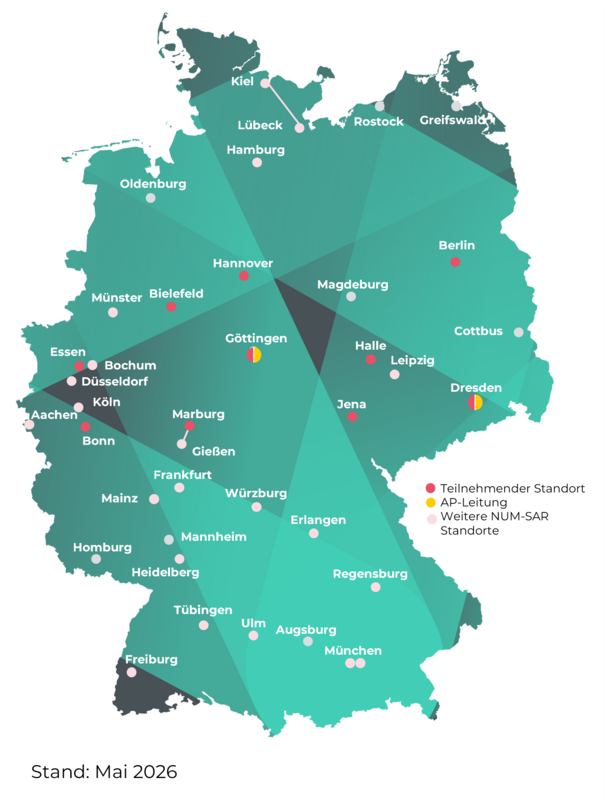
As part of NUM-SAR, the MuSE module is linked to other complementary modules that focus on rapid data integration and predictive modelling. This networking enables the continuous exchange of harmonised data streams, analysis results and situation assessments between the modules and promotes a coordinated approach to pandemic surveillance, early warning and health system resilience. By systematically linking surveillance, predictive analytics and operational response structures, NUM-SAR enables university hospitals to react and act in a harmonised and timely manner in the event of developing health crises.