

Goals and fields of work
Together with the Robert Koch-Institute (RKI) and other experts, GenSurv is developing a national network for genomic pathogen surveillance by efficiently bringing together, evaluating and (further) developing strategies, technologies and expertise relevant to surveillance and making them available for joint use. In particular, this includes strategies for the selection and sampling of relevant infectious agents, the establishment of a data infrastructure for the storage and analysis of infectious agent sequencing data and the linking of this data with selected information on the behaviour of the pathogen and the context in which the infection occurred. GenSurv is designed to be scalable and internationally compatible. The module is based on trusting cross-institutional, cross-sector and cross-professional and supra-regional collaboration. The principles of openness, collaboration, quality assurance and efficiency in accordance with the FAIR principles form the basis of the collaboration.
Course of the project
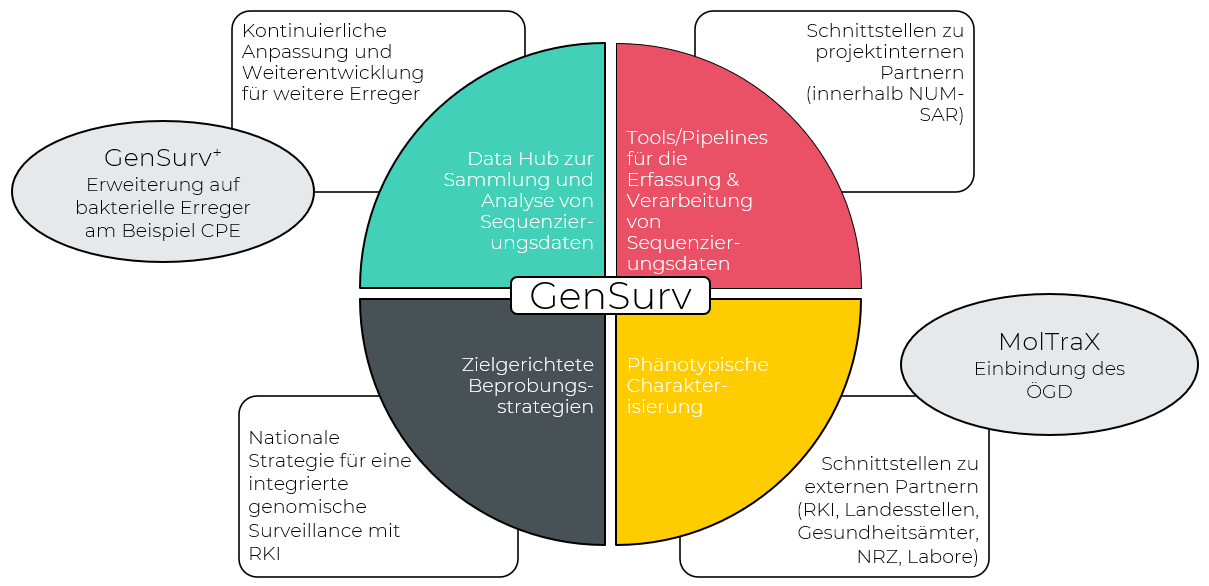
GenSurv was initiated in the first funding phase as part of the B-FAST research project. In the second funding phase, GenSurv was continued and consolidated as an independent infrastructure. As part of two research projects(MolTraX and GenSurv+), the infrastructure was systematically trialled and further developed in terms of content and technology. In the third funding phase, GenSurv will be continued as a module of the NUM-SAR infrastructure. As part of the funding, the concept developed together with the Robert Koch-Institute will be further pursued and expanded.
The MolTraX project addressed the systematic integration of the public health service, while GenSurv+ demonstrates the transferability of the infrastructure originally developed for SARS-CoV-2 to bacterial pathogens with antimicrobial resistance. GenSurv is designed for continuous expansion to other pathogens and has interfaces to internal project partners within NUM-SAR.
Contact persons
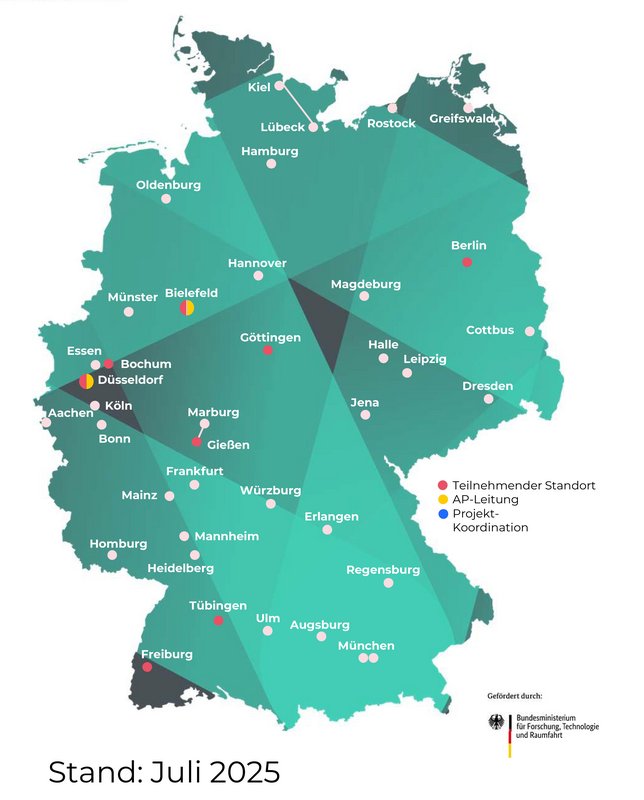
The GenSurv spokespersons are Prof Dr Alexander Dilthey (Düsseldorf) and Prof Dr Claudia Hornberg (Bielefeld). Prof Dilthey will be represented by PD Dr Ulrike Loderstädt (Göttingen) until mid-2026. Anna Bludau (Göttingen), Airin Franke and Markus Tröger (both Bielefeld) will coordinate the project. A total of seven university hospitals are involved in GenSurv as well as the Robert Koch-Institute as an associated partner.