
Quality assurance
In cooperation with the BioMaterialBank Heidelberg (BMBH), the Integrated Biobank Jena (IBBJ) and the BioBank Dresden (BBD), GBN regularly carries out proficiency tests with partner biobanks. Both tissue and liquid biosamples are analysed. The biobanks use proficiency tests to check sample quality and thus their processes – from sample receipt and storage through to derivative preparation and measurement.

Interlaboratory tests
with different sample types

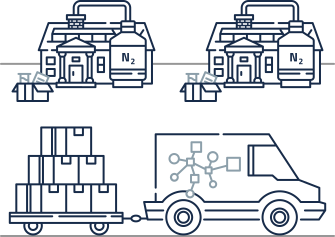
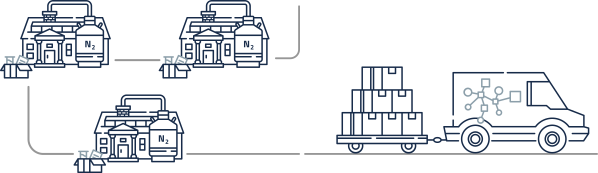
Step 1: Preparation and dispatch
The organisers send biosamples to all participating
biobanks of the German Biobank Network (GBN).

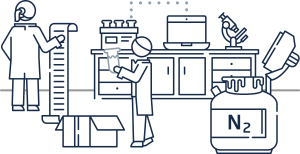
Step 2: Processing
The biobanks process the samples according to their procedural instructions and in accordance with the specifications in the EQA scheme.
Step 3: Packaging and return shipment
They then return the samples as specified.


Step 4: Analysis
The organisers check the samples and evaluate the associated data.
Step 5: Feedback
They discuss the results individually with the biobanks and suggest improvements.

Tissue proficiency tests
In order to minimise or ideally eliminate the influence of pre-analytical processes on the quality of human tissue samples, GBN established tissue proficiency tests for GBN biobanks in 2017 in close collaboration with the Heidelberg site. Participation has a modular structure so that biobanks can select the modules that are relevant to their individual processes and quality objectives. The modules including evaluated processes/parameters at a glance:
- Cryogenic tissue: cutting, cryopreservation, sectioning, H&E staining, RNA extraction, quality control
- FFPE tissue: cutting, sectioning, H&E staining, suitability of the material for IHC, immunofluorescence and spatial analysis
- Pathological-anatomical assessment: assessment of various parameters, e.g. tumour content
- Virtual microscopy: scan sharpness
Once participation has been completed and all results analysed, the biobanks receive a comprehensive, detailed report. In addition, there is the opportunity to discuss the results in a personal feedback meeting and develop specific improvement measures.
The tissue proficiency test provides biobanks with long-term support in quality assurance, strengthens the reproducibility of research results and contributes to the harmonisation of the relevant processes. For example, the RNA yield from cryogenic tissue has already been increased across all sites. Biobanks that want to systematically review and further develop their quality standards benefit greatly from participating.
PBMC proficiency test
Peripheral blood mononuclear cells (PBMCs) have also become increasingly relevant for biobanks as a result of the coronavirus pandemic. In order to assess the viability and functionality of PBMCs, GBN organised a proficiency test for 12 biobanks in 2020 in collaboration with the Integrated Biobank of Luxembourg (IBBL). GBN defined the workflow in cooperation with BioBank Dresden (BBD). The results help to improve processes.
Overview of GBN biobanks with information on participation in proficiency tests