

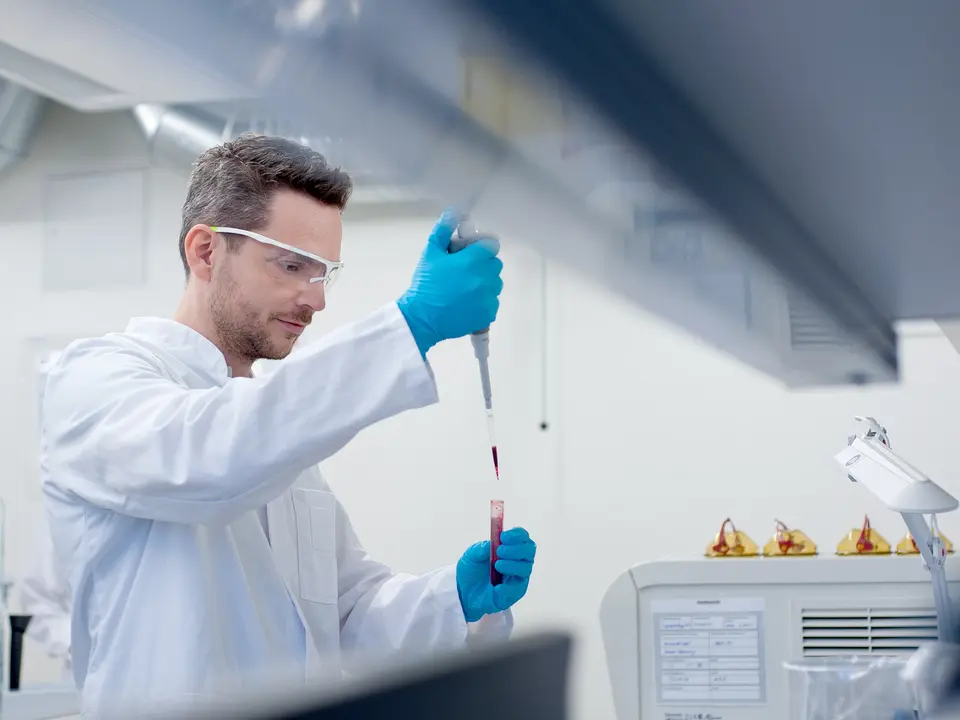

From the initial consultation to the storage of samples and data management - GBN biobanks offer a comprehensive service. Thanks to standardised workflows and a high degree of automation, they create the conditions for reproducible research results.
The services offered by GBN biobanks include
- Consultancy on all aspects of biobanking (e.g. consideration in study design) and project management
- High sample quality through prompt and professional processing
- Additional processing services (e.g. DNA extraction) depending on the location
- Clear documentation in special biobank software (external access possible at some sites) and linking of biobank data with clinical information
- Storage and retrieval of samples "on demand"
- Secure storage in partly robot-controlled cooling systems at -20, -30 or -80 degrees Celsius or at approx. -165 degrees Celsius in the gas phase of liquid nitrogen
- Monitoring around the clock; issuing GCP-compliant proof of temperature compliance
The GBN biobanks have established common quality standards. Compliance with these standards is ensured through internal audits and so-called round robin tests, in which samples of identical starting material are processed in all biobanks, analysed by a reference laboratory and the results evaluated for comparison. In addition, the majority of GBN biobanks are certified or accredited.
Whether liquids, tissue samples, pre-processed or not - there are hardly any restrictions for samples to be stored. The information provided on the samples is very important for biobanks.
The study management should provide at least the following data in digital form:
- the donor and study ID,
- the sample type
- the volume,
- the number of sample aliquots,
- the year of birth and gender of the respective donor,
- as well as the ICD-10/ICD-O code (for tumour entities, histology, staging, localisation of the primary tumour/metastasis, if applicable).
The following additional information is desirable:
- Information on the status of the informed consent form,
- Information on the pre-analytical process, such as
- the collection date/time,
- for samples that have already been frozen: Date and time of freezing.
The costs depend on the amount of work involved. It depends, for example, on the quantity of samples, whether and how they are processed in the biobank and whether further analyses are to be carried out. GBN biobanks provide transparent quotes for this - reduced prices generally apply for on-site studies.
The rights to samples and associated data from clinical studies remain with the respective study management. Samples and data can only be used for other projects with the consent of the study director. Information on the collections of the GBN biobanks can be found in highly aggregated form in the BBMRI-ERIC directory or sample-specific via the GBN sample locator (e.g. sample type, ICD-10/ICD-O code, number).
Biobank employees can help to select a form of consent (e.g. study-related and/or "broad consent") and edit the text. The Association of Medical Ethics Committees in the Federal Republic of Germany (AKEK) offers a broad consent model text for the use of biospecimens and associated data in biobanks. Broad consent is a consent procedure that enables the collection of samples for research in a medical context with a long-term storage period without being tied to specific research purposes.