

What are the Research Infrastructures in the NUM?
NUM Research Infrastructures support researchers with methodological expertise, data management and high-quality research data
At the beginning of the COVID-19 pandemic, there was a widespread lack of the necessary platforms to collect and store treatment data and biosamples in a structured manner across institutions and make them available for use. For this reason, research and data infrastructures were either set up from scratch in several NUM projects (e.g. the NUM Platform for Imaging Data RACOON) or existing ones were expanded (e.g. the NUM Clinical Epidemiology and Study Platform NUKLEUS).
As medical research data is extremely heterogeneous, there can be no "one size fits all" infrastructure solution for clinical research data. Accordingly, the NUM has set up Research Infrastructures for different types of data, different ways of obtaining data and different treatment settings. To ensure that these partial solutions complement each other optimally and are compatible at their interfaces, these platforms all work on the basis of the FAIR (Findable, Accessible, Interoperable, and Reusable) principles.
Implementation is in the hands of nationwide interdisciplinary expert networks, each of which contributes specific expertise on certain types of data (e.g. imaging data, autopsy data, emergency admission data) to NUM. The resulting NUM platforms are used by the NUM research projects and will also support researchers outside the NUM in their research projects in the future.
The NUM currently has the following Research Infrastructures, each with a different focus:
The NUM Platform for Acute, Intensive and Emergency Medicine (AKTIN) provides real-time research and monitoring in healthcare, specifically in emergency and acute medicine. The platform makes it possible to automatically record standardised clinical data from patient care on a daily basis - across locations and independently of the primary electronic documentation systems, in compliance with data protection regulations.
The German Biobank Network (GBN) brings together academic biobanks in Germany that collect human biospecimens and make them available for research, and offers them a joint platform for collaboration and further development. The GBN represents German interests in the European biobank network BBMRI-ERIC and supports biomedical research on the path to precision medicine.
The NUM Platform for Autopsies and Pathology (NATON) pools the expertise of university and non-university specialists in Germany who deal with autopsies and the analysis of post-mortem samples. The aim of NATON is to promote and support autopsy research in a variety of areas and to act as a platform for pandemic preparedness.
The NUM Clinical Epidemiology and Study Platform (NUKLEUS) supports researchers from the planning and implementation to the evaluation of clinical and clinical-epidemiological studies. The platform is also responsible for accepting and processing external healthcare-related data (DAAeD).
The NUM Study Network is developing an effective system of cooperation in the field of clinical and clinical-epidemiological studies. Study managers are relieved of administrative and operational tasks by consistently simplifying them and transferring them to study-supporting structures. As a result, more studies can be initiated in less time, more patients can be recruited for studies in a reliable period of time and the quality of data and biosample collection can be improved.
The Study Network Infectious Diseases (SNID) supports clinical and clinical-epidemiological studies in the field of infection medicine and is intended to help strengthen the research landscape in Germany in the long term.
The Study Network Critical Care (SN CritCare) aims to establish a high-performance, nationwide network of university study centres that will sustainably strengthen clinical research on critically ill patients with acute organ dysfunction. An efficient and resilient recruitment network forms the central foundation for this.
The Study Network Stroke (SN Stroke) is building a nationwide infrastructure for transformative, large-scale clinical trials in the field of stroke prevention and treatment. The aim is to improve the treatment of stroke patients in all phases of care through clinical studies with direct potential to change guidelines and standards of care and to give them early access to innovative therapy concepts.
The NUM Data Integration Centres (NUM-DIZ) provide data, integrate it across sites and analyse it. In order to integrate them into the National Research Data Infrastructure Germany, both the already established and the newly emerging data integration centres are connected to the central Research Data Portal for Health (FDPG).
The NUM Platform for Imaging Data (RACOON) makes medical image data quickly and efficiently usable for research. The aim is to create a platform that serves as a user-friendly and intuitive tool for radiologists and researchers from all over Germany. This allows mono- or multi-centre studies with medical image data to be planned, carried out and evaluated more quickly.
The NUM Methods & Biosamples Hub (NUM-MB) will provide all researchers and infrastructures in the NUM with comprehensive, easily accessible and needs-based support on methodology, biosamples and specific regulatory aspects along the entire study process.
The NUM Platform for Surveillance and Rapid Response (NUM-SAR) strengthens the infrastructure of university medicine for pandemic-related research through knowledge creation, standardised data systems and comprehensive pathogen surveillance. The Research Infrastructure provides important information for pandemic prevention and complements existing laboratory structures of the Public Health Service (ÖGD). This forms the necessary basis for effective control and management of future pandemics.
A central task of the NUM is to make these Research Infrastructures permanently available and to continuously develop them further. This includes the further expansion of the NUM platforms into a Germany-wide data space for all types of clinical research data. This should be widely available for use by the scientific community in line with the open science concept.
Vision of the NUM FIS
"The Network of University Medicine provides THE national Research Infrastructure with needs-orientated solutions for practice-changing health research. This Research Infrastructure creates optimal conditions for researchers, strengthens responsiveness and enables coordinated action."
Mission of the NUM FIS
We operate a transparent, user-friendly and scalable infrastructure that is based on trust-based collaboration and interdisciplinary expertise and provides researchers with the best possible support for multicentre collaborative projects across the entire research chain.
To this end, we provide researchers with a comprehensive portfolio of instruments, advice and services to collect high-quality research data and biosamples. We make these available to the scientific community based on the FAIR principles as well as legal, organisational and technical standardisation and harmonisation. This enables us to gain scientific knowledge that enables improved prevention and treatment of diseases and thus contributes to people's health.
A key component in realising this vision is the creation of a data room for clinical research data in Germany. In the future, this data room should contain all types of clinical research data. This applies regardless of whether it is data from routine clinical care or data collected in addition to routine documentation in clinical studies.
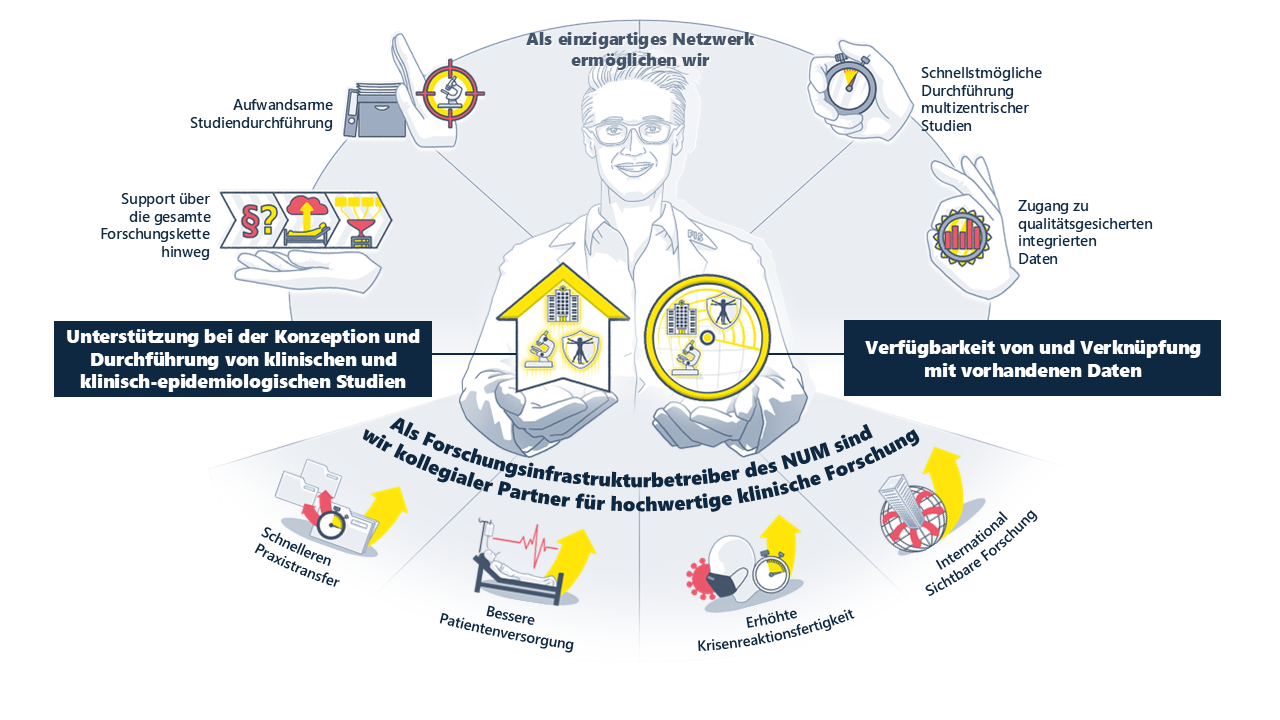
In order to realise this vision, the "Steering Committee of the NUM research infrastructures" was set up for the overarching management and further development of the NUM research infrastructures. It ensures that further infrastructure development is carried out by researchers for researchers and that the needs of research data users are taken into account as much as possible.