

About the project
Prostate cancer is the most common form of cancer among men in Germany. The number of new cases is expected to double by 2040.
If cancer is suspected (usually triggered by an elevated protein level, known as the PSA level, in the blood), a magnetic resonance imagin (MRI) scan of the prostate is now usually carried out before a decision is made on whether to take a tissue sample. The problem is that in up to 50 per cent of cases, the initial suspicion of cancer is ultimately not confirmed. For those affected, this means uncertainty and, in some cases, unnecessary follow-up examinations – and MRI appointments are in short supply.
RACOON-PROSTAIT therefore aims to assess more accurately, even before imaging takes place, who really needs an MRI, and to this end combines two approaches:
Key points at a glance
PROSTAIT is investigating whether a genetic risk assessment and AI-assisted image analysis can provide a better prediction of who would benefit from a prostate MRI scan.
Objective 1: Utilising genetic riskprior to imaging (Work Package 1)
The project is investigating how well the polygenic risk score determined from saliva – both on its own and in combination with clinical data such as age and PSA level – correlates with MRI findings. It is expected that the results of the ProGene pilot study at Charité will be confirmed in a Germany-wide study cohort. Men at high risk of a tumour requiring treatment could then be prioritised for an MRI scan, whilst others would be spared the procedure.
Objective 2: AI that uses more than just images (Work Package 2)
Existing AI models for MRI analysis are to be expanded to include genetic, laboratory and clinical information. Such a model is intended to detect prostate cancer more reliably and make diagnostic findings more comparable across hospitals.
The project in figures:
• 443 participants – men aged between 50 and 70 with no known prostate cancer
• 7 recruiting university hospitals
• 1 one-off saliva sample per participant, non-invasive and without additional blood sampling
• 12 months of follow-up
• Duration: February 2026 to July 2028
The conflicting objectives of early detection
The aim of early detection of prostate cancer is to identify aggressive tumours at an early stage without placing an unnecessary burden on healthy men. Today, the process usually begins with a PSA test – a marker that is widely available but not very accurate. The result: up to 50 per cent of the MRI scans ordered as a result show no evidence of cancer. For those affected, this means uncertainty and, in some cases, unnecessary follow-up examinations. For the healthcare system, it means that scarce MRI capacity is not being allocated where it would be of greatest benefit – whilst demand is rising.
MRI itself also has its limitations: interpreting the results is complex and depends on experience. Despite standardised assessment criteria, findings vary. AI can help here. However, its clinical use has so far often failed because its decisions are not transparent and because it has not been validated across different sites and devices.
The knowledge gap
It is well established that genetics play a significant role in the development of prostate cancer. However, whether a genetic risk assessment is suitable for selecting the right men for imaging even before the scan has hardly been investigated to date. PROSTAIT closes precisely this gap.
Challenges in implementation
- Seven sites, comparable data: the clinics use different MRI scanners. To ensure the results remain reliable, standardised examination protocols, structured reporting and ongoing quality control are required. This technical diversity is also a strength: it ensures the results are transferable to everyday clinical practice.
- Protection of genetic data: Genetic data requires particular protection. PROSTAIT works exclusively with pseudonymised data, utilises the multi-tiered data protection concept of the NUM infrastructures, and specifically examines individual genetic variants rather than the entire genome.
- Relevance for all: The project deliberately recruits participants from different regions and discloses the composition of the study group in all publications.
Study design
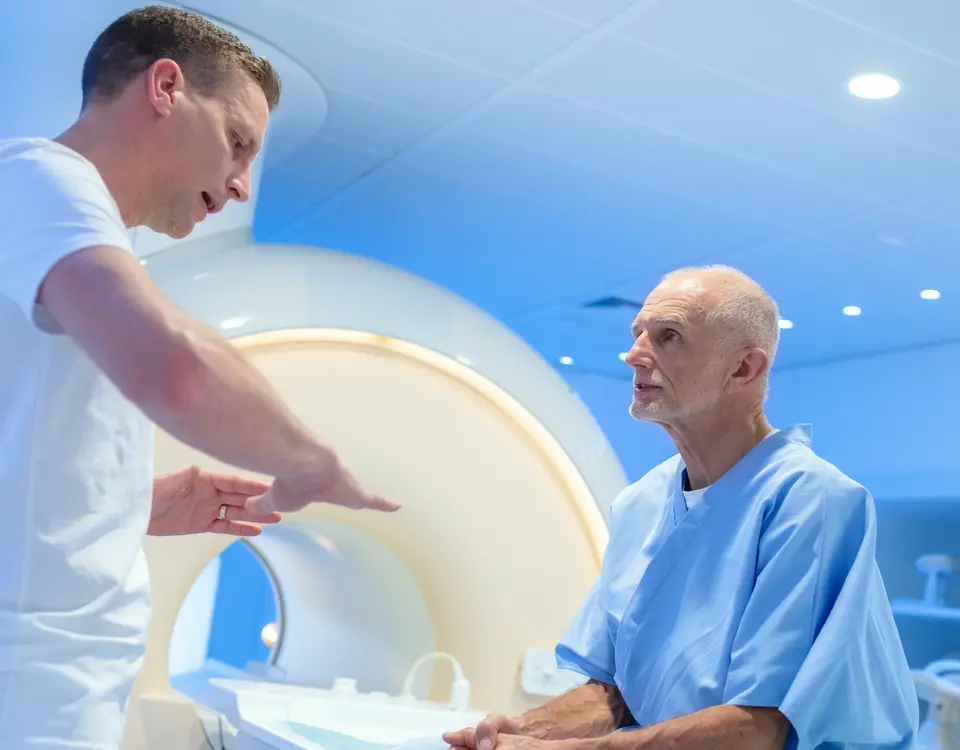
PROSTAIT is an observational study being conducted at seven university hospitals. Men aged between 50 and 70 who are scheduled to undergo a prostate MRI scan for medical reasons and who have not previously been diagnosed with prostate cancer are eligible to take part. All examinations and treatments will continue to be carried out as required by medical necessity and in accordance with current guidelines; the study will not interfere with treatment.
Here’s how participation works
1. Information session, consent form and a short questionnaire on the day of the already scheduled MRI scan (15 to 20 minutes).
2. Prostate MRI scan following a protocol agreed upon by all sites and with a structured reporting format.
3. A single saliva sample (2 minutes) for subsequent genetic analysis.
4. Follow-up after twelve months, by telephone or post (10 to 15 minutes).
The two work packages
Work package 1: Recruitment at the seven sites, MRI scans and saliva samples, establishment of the shared database, and evaluation of how well the genetic risk assessment predicts the MRI findings.
Work package 2: Establishment of the first Germany-wide prostate MRI database and further development of the AI. The consortium is building on its own preliminary work: a model that identifies suspicious areas and provides a transparent rationale for its assessment, and a method that automatically measures the prostate. Both will be validated using an independent dataset. The Charité is responsible for coordinating both work packages.
Ethics and data protection
The study will be reviewed under the ‘One Study – One Vote’ procedure, led by the Ethics Committee of Charité – Universitätsmedizin Berlin. Data processing is based on the participants’ written consent in accordance with the GDPR. The study will be publicly registered before recruitment begins.