



About the project
Candidaemia is a serious infection in which fungi enter the bloodstream. It can be life-threatening. About every second person affected dies from it.
The current guideline recommends treating this infection with an antifungal drug for 14 days after fungi are no longer detectable in the blood. However, this recommendation is not based on evidence-based, i.e. reliable scientific proof.
The CanTEN study is therefore investigating whether a shorter treatment period is just as effective and safe. The study is designed as a multi-centre, randomised, double-blind, placebo-controlled, adaptive non-inferiority study: it is being conducted across 25 university hospitals. The patients are randomly assigned to different treatment groups, and neither they nor the treating physicians know who will receive the antifungal drug or the placebo and for how long. This is to ensure that the results are as reliable as possible.
The most important facts at a glance
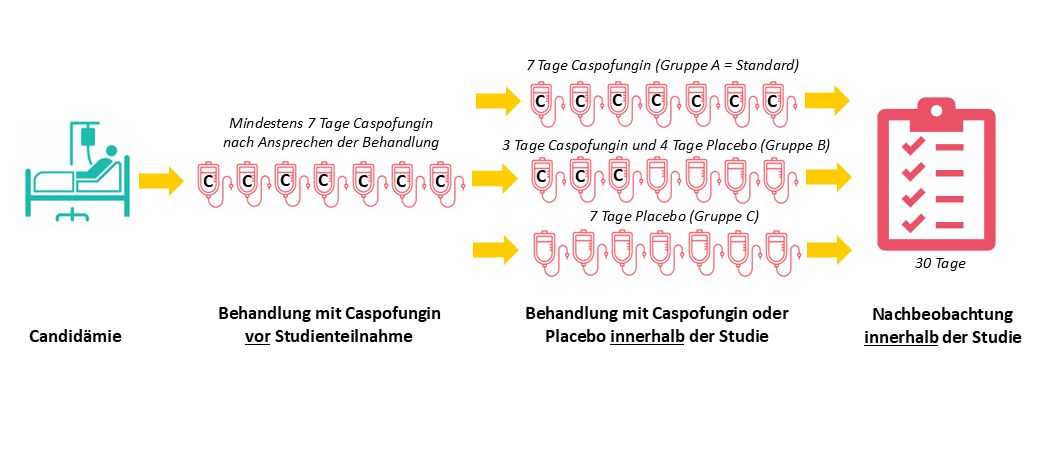
The main aim of the study is to find out whether a shorter treatment with the drug caspofungin works just as well as the standard 14-day treatment after fungi are no longer detectable in the blood.
The first step is to investigate whether a 10-day treatment is just as effective as the standard 14-day treatment. If this proves to be the case, the next step is to examine whether a 7-day treatment is just as effective as a 10-day treatment.
The decisive factor for the assessment is whether or not the infection recurs within 30 days of the end of treatment.
The study also investigates
- Exactly how long it takes for the infection to possibly recur
- How many patients are cured in total
- How many patients die overall or as a result of the infection
- The extent to which the healthcare system is burdened by the treatment (e.g. in the form of hospitalisation costs)
- How well the antimycotic is tolerated
- How patients themselves assess their state of health and quality of life
It is also checked whether certain factors influence the risk of a recurrence of the infection, for example
- Age and gender
- other existing illnesses
- how severely the patient's important organ function is impaired
- whether circulatory support medication is necessary
- and what type of fungus has caused the infection
With an incidence of 3.9 per 100,000, candidaemia is a rare disease. Patients with this serious disease can therefore only be included in a clinical trial in sufficient numbers in the NUM network. The CanTEN study is also only aimed at the subgroup of patients with uncomplicated candidaemia in order to ensure the safety of the study participants.
CanTEN is a randomised, double-blind, placebo-controlled, non-inferiority study with an adaptive design. Depending on the results of the interim analysis, one of four predefined scenarios can be implemented. A total of between 106 and 420 patients will be included. Recruitment will take place at 25 trial centres throughout Germany.
Organisation & coordination:
- Sponsor: University of Cologne
- Coordinating study centre: University Medical Center Göttingen
- Further partners: NUKLEUS CDM, DUA, EC, LIMS, RPA, THS and TO; NUM-MB BCU
- Further diagnostics of Candida isolates: National Reference Centre for Invasive Fungal Infections (NRZMyk)
- Patient representation: Deutsche Sepsis-Hilfe e.V.