


Severe menstrual pain is often considered "normal" - but it can be an indication of adenomyosis, a form of endometriosis. Many sufferers wait an average of 8-10 years for a diagnosis. This is precisely where the NUM research project RACOON FADEN (Early detection of Adenomyosis) came in: The aim was to visualise early pathological changes in the uterus using MRI and thus significantly shorten the diagnostic pathway for young patients.
In a multi-site study led by the University Hospital Erlangen and Charité - Universitätsmedizin Berlin, over 200 young women with cycle-dependent lower abdominal pain and healthy test subjects were examined using multiparametric MRI - in each case during the period of menstruation and ovulation. The prospective comparative study was conducted using the NUM Platform for Imaging Data RACOON (Radiological Cooperative Network) and NUKLEUS (NUM Clinical Epidemiology and Study Platform).
A tissue layer between the mucosa and the muscles of the uterus, the so-called junctional zone, was previously used as a stable structural marker for adenomyosis. Using the AI-supported CuraMate platform, the project developed an automated deep learning workflow for precise segmentation of the uterus.
Based on these manual and automated analyses, the study is already providing new insights into the junctional zone as a biomarker. Surprisingly, it was found that the junctional zone not only changes dynamically between the examination times, but also during an examination and thus presumably reflects muscle contractions. Furthermore, there was no significant difference in junctional zone thickness between symptomatic and asymptomatic women at the same time of the cycle, which calls into question the quality of the junctional zone as a static diagnostic criterion. This finding indicates that the entire uterus, in particular its peristalsis (contraction), must become an even greater focus of research in the future. It is important to coordinate the time of examination with the female cycle.
RACOON FADEN has created reliable reference data on the healthy uterus compared to the symptomatic uterus for the first time. This makes it all the more important to utilise this data set in a targeted manner for further research into adenomyosis.
Results from RACOON FADEN - Early detection of an overlooked disease
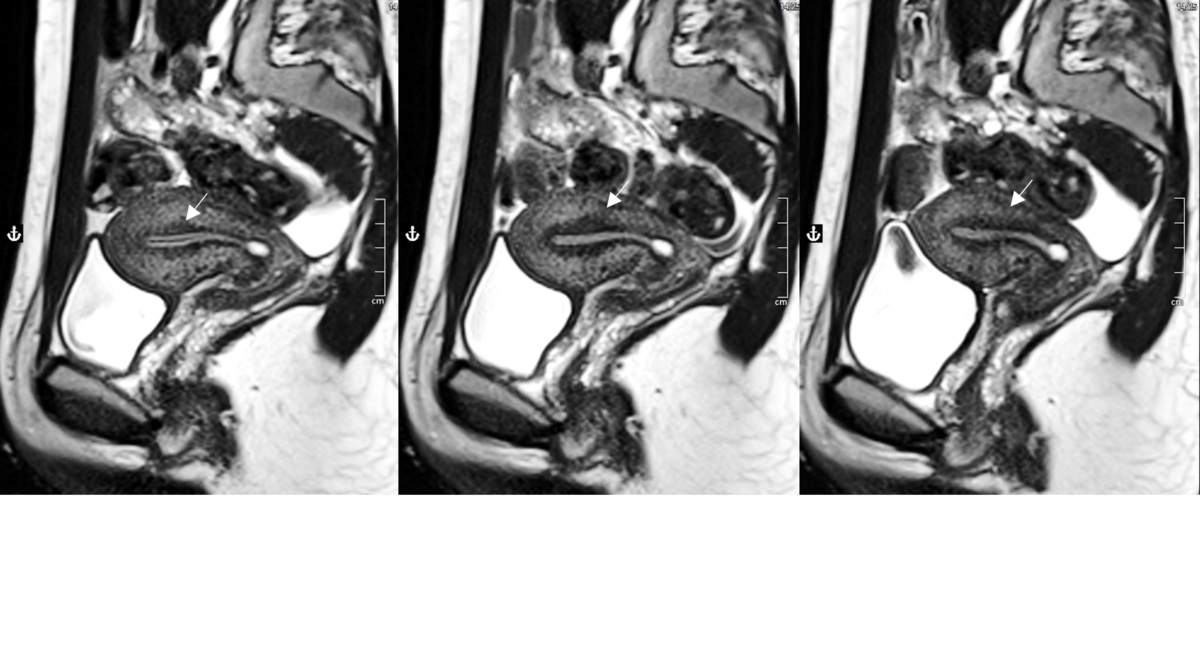
Figure 1: T2w HASTE sagittal left initial compared to the repetitions of the MRI sequence recorded at intervals of 10 min (centre) and 17 min (right). A clear variability of the morphology and thickness of the junctional zone (JZ) is recognisable, as well as a thickening of the anterior wall in the right image. Radiological Institute, University Hospital Erlangen