

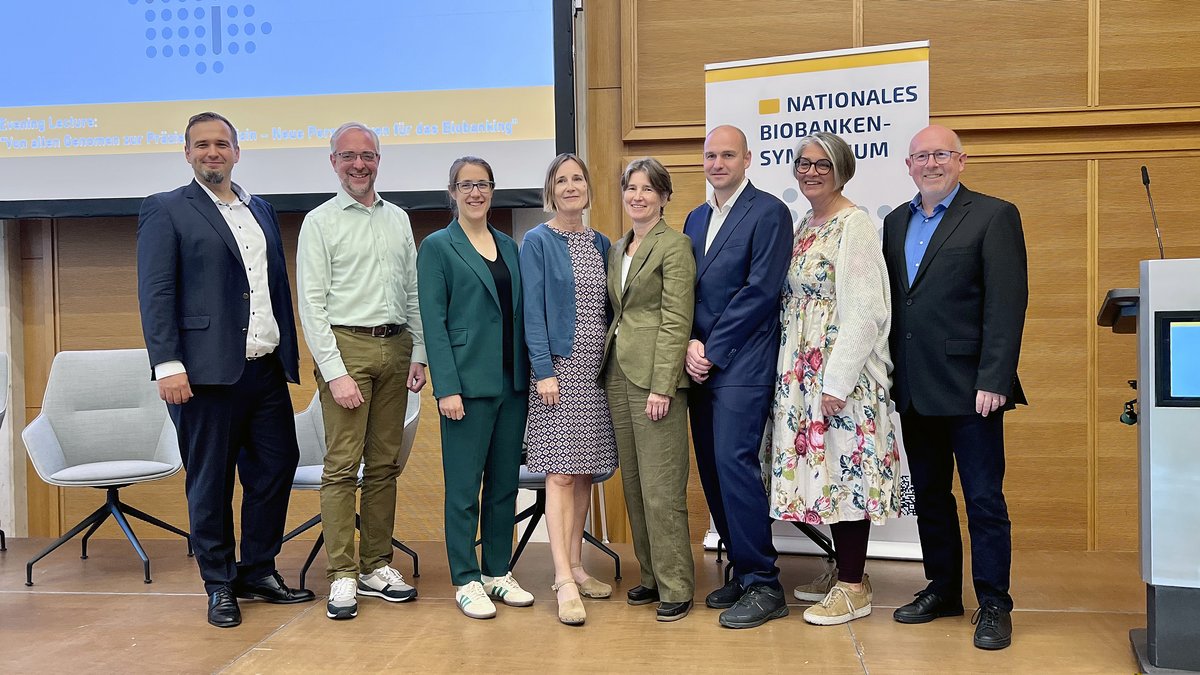
Around 200 experts from biobanks, research, healthcare and industry gathered in Berlin on 15 and 16 September 2026 for the 14th National Biobank Symposium. Under the theme ‘Rethinking Biobanking!’, they discussed the future of biobanking, the linking of biosamples and data, and new approaches to quality, standardisation and sustainability.
New structures for biobanking
The focus was on the “Biobank Platform for Germany”, which has been under development since July 2026 as a new project within the Network of University Medicine (NUM). A dedicated session was held to present the project’s various areas of work. These include, amongst other things, the IT infrastructure, the “NUM Biobank” and regional networking. It became clear how closely the individual areas are interlinked and how many interfaces there are with existing NUM structures – such as the Data Integration Centres (NUM-DIZ) and the Study Network (NUM-SN).
“Biobanks have long since ceased to be merely collections of high-quality biological samples and associated data; they are now integral components of a networked, data-driven research landscape,” said Dr Ronny Baber, conference chair of the symposium, Director of the Leipzig Medical Biobank (LMB) and board member of the German Biobank Network (GBN).
The importance of the biobank platform for collaboration with industry was also discussed. A panel discussion focused, amongst other things, on standardised data, different sample types, a clear legal framework, and efficient and flexible processes. This addressed key requirements that also play an important role in the development of the platform.
Biobanking in a state of flux
The symposium also highlighted the diverse nature of current developments in biobanking. Topics presented included tumour organoids, automated storage infrastructures and new technological solutions for laboratory operations. Issues relating to quality assurance, standardisation and sustainability were a recurring theme across various sessions.
German Biobank Network (GBN) represented with a poster award
For the GBN, the symposium provided various opportunities to bring the network’s current work into the discussion. This was particularly evident in the poster awards: Dr Philipp Schöppner and Nicole Niehoff were honoured for their poster ‘Are cryopreserved PBMCs fit-for-purpose? A systematic review by the GBN PBMC working group’.