

About the project
The Biobank Platform within the Network University Medicine (NUM) is a key component in strengthening medical research and innovation in Germany. It brings together decentralised structures to form a comprehensive, service-oriented platform that enables the sustainable use of health data and biological samples. Easy access, together with uniform quality and data protection standards, fosters trust and reliability.
As a participatory project, the platform actively involves researchers, clinics, industry, patients and funding bodies. Through the feedback of analysis data, users also become co-creators of the platform, shaping its further development. This creates a dynamic network that brings medical advances into clinical practice more quickly.
Key points at a glance
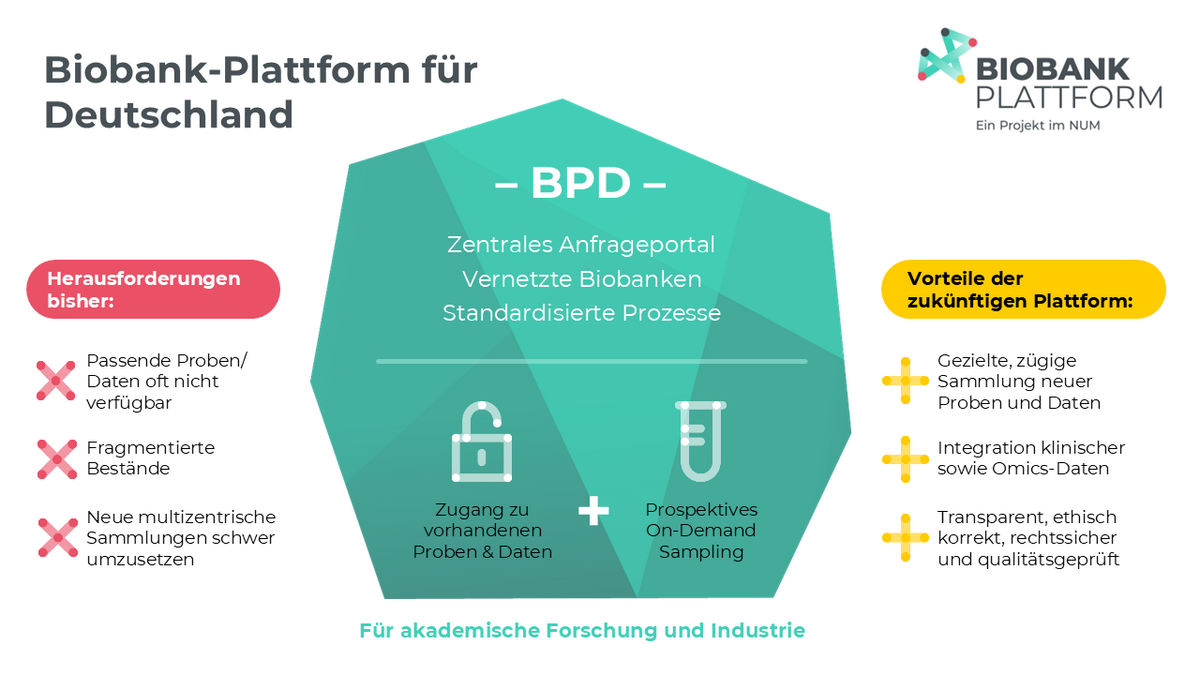
The Biobank Platform for Germany is establishing a nationwide Research Infrastructure to provide standardised access to quality-assured biological samples and the associated clinical and analytical data. A key objective is cross-site ‘biobanking on demand’: researchers should be able to request specific biological samples and data for their research questions via a one-stop shop – both from existing collections and through prospective, multicentre sample collection. This is complemented by the integration of omics and other analytical data, common quality and access standards, and the gradual integration of regional healthcare partners beyond university hospitals, in order to increase the diversity of available samples and data and to enable research across the entire care pathway.
The underlying concept was developed within the University Medical Centre in collaboration with the German Biobank Network (GBN), Fraunhofer Health, the German University Medical Centres, the Technology and Methods Platform for Networked Medical Research (TMF), the Association of Research-Based Pharmaceutical Companies (vfa), the German Pharmaceutical Industry Association (BPI), the German Diagnostics Industry Association (VDGH) and the biotechnology association BIO Deutschland.
The biobank platform builds on the established structures of the German Biobank Network (GBN) and is being implemented in collaboration with all NUM university hospital sites. In addition to setting up a central access portal, existing biobanks, Data Integration Centres and other NUM Research Infrastructures are being linked together both technically and organisationally. This is complemented by quality assurance measures, the integration of analytical data (particularly omics data), training programmes for participating specialist groups, and pilot projects to involve regional hospitals and GP practices. Strategic management is carried out by an interdisciplinary Steering Committee, which also includes representatives of patients, industry and the Association of German Medical Faculties (MFT).
Work packages:
- NUM preparedness of biobanks, long-term sample management and overall coordination – led by Dr Gabriele Anton (Bielefeld) and Dr Heidi Altmann (Dresden)
- Integration of the BPD into NUM infrastructures and across Europe (BPD IT), led by: Prof. Dr Martin Lablans (Heidelberg), Prof. Dr Thomas Ganslandt (Erlangen)
- NUM Biobank (NUM-BDB), led by: Prof. Dr Thomas Illig (Hanover), Dr Gabriele Anton (Bielefeld)
- Transparent, ethically and legally sound, and sustainable cooperation models, led by: Dr Ronny Baber (Leipzig), Dr Romy Kirsten (Mannheim), Dr Alexandra Stege (Berlin)
- Standardisation, Qualification and Sustainability, led by: PD Dr Dr Michael Kiehntopf (Jena), Dr Alexander Brobeil (Heidelberg), Dr Heidi Altmann (Dresden)
- NUM Academy, led by: PD Dr Sara Nußbeck (Göttingen), Dr Daniel Brucker (Frankfurt)
- Regional Networking – Establishment of an intersectoral biobank hub network – Led by: Prof. Dr Alexandra Nieters (Freiburg), Dr Heidi Altmann (Dresden)
- Integration of routine samples from pathology and clinical laboratory medicine into NUM infrastructures – Led by: Prof. Dr Peter Boor (Aachen), PD Dr Dr Michael Kiehntopf (Jena)
The Biobank Platform builds on the successful groundwork laid by the German Biobank Network (GBN). The GBN has linked 43 academic biobanks across Germany, introduced binding quality assurance standards and developed the ‘Sample Locator’ (samplelocator.bbmri.de), a central tool for searching for biological samples. As the “National Node” of the European Research Infrastructure BBMRI-ERIC, the GBN also promotes international exchange in biobanking. In 2025, the GBN was integrated into the NUM – an ideal starting point for systematically developing the existing structures into a national biobank platform.
As part of the project’s political kick-off event on 22 June 2026 in Berlin, project coordinator and GBN board spokesperson PD Dr Sara Nußbeck gave an introductory talk – the recording is available here. Further video recordings of the event can be found here.