

Importance of autopsies

Clinical and forensic autopsies are comprehensive medical examinations of the deceased that serve to clarify the cause of death, verify diagnoses and therapies and expand medical knowledge. For relatives, they provide clarity about the cause and circumstances of death, help them to cope with grief and, in the case of hereditary or infectious diseases, can provide important information for the bereaved. The aim is to recognise familial or infectious diseases in relatives at an early stage - or ideally even before they break out - and to be able to protect them in the best possible way through suitable preventive measures. Post-mortems provide valuable insights for doctors by confirming known diagnoses and, in many cases, adding previously unknown diagnoses. In scientific terms, post-mortem examinations contribute to the understanding of disease development and progression, improve therapeutic approaches and diagnoses and support the training of medical professionals with sound findings.
The clinical post -mortem (also known as an autopsy, necropsy or internal post-mortem examination) involves a thorough external and internal medical examination of the deceased. The clinical autopsy is carried out by doctors who specialise in the examination of organs and tissues, the pathologists.
In addition to the clinical autopsy, there is also the forensic autopsy, which is carried out in forensic medicine by forensic pathologists who are specially trained to investigate unexplained deaths.
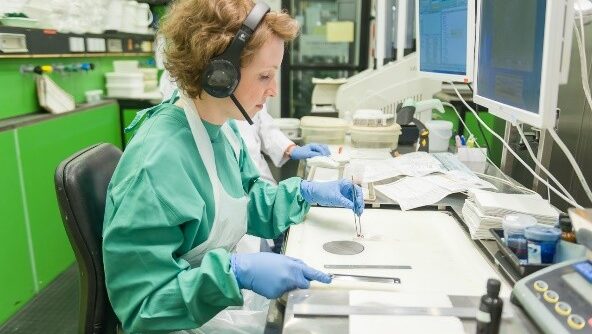
Respect for the deceased and respect forhuman dignity characterise the conduct of all post-mortem examinations. As part of the examination, all organs are first assessed with the naked eye, weighed and measured. Tissue samples are then taken for microscopic (i.e. histological) or molecular (genetic) analyses.
The clinical autopsy is intended to answer unanswered questions from the family and the treating doctors. This applies in particular to questions regarding the main cause of death, but also to other diseases (and disease processes ) that may not have been recognised until then. Even in the modern age of medicine with its many examination methods, the clinical autopsy makes medically important observations and regularly provides new insights. The exact determination of the cause of death is often of particular importance for the family in coping with grief and saying goodbye. It answers the pressing question of "why".
A forensic post-mortem examination, on the other hand, is mainly carried out in cases where the cause of deathis unclear or not natural, for example if a criminal offence, accident or suicide is suspected. It is ordered by the public prosecutor's office and serves to clarify the exact cause of death and to reconstruct what happened before death. There is no possibility for relatives to refuse a forensic autopsy.
Post-mortems are also extremely relevant for clinical research. The causes of many diseases are still unclear and have not been sufficiently researched. This is mainly due to the fact that it is not possible to examine the diseased tissue during the lifetime of the person affected. Medical research on human tissue and body fluids obtained after death therefore has an extremely important role to play in better understanding the causes of diseases and finding targeted new therapies. A biobank with human tissue from patients with various underlying diseases is therefore an important prerequisite for future medical progress.
In addition to clinical and forensic autopsies, there are also official, insurance-related and private autopsies. They also serve to clarify the cause of death in official, insurance-related or personal matters and thus support the investigation of a death.

A written report is prepared once the tests have been completed. A preliminary report with all the key findings is available within a few days. This usually already contains all the important information. A final assessment report usually takes a few weeks, as a variety of additional examinations have to be completed first. These reports are sent to the treating doctors and attached to the medical records and, if requested, also sent to the deceased's GP practice. Relatives can therefore receive information about the results months and years after a clinical post-mortem examination. By arrangement, the results of the post-mortem examination can also be discussed in person with the next of kin.
If a post-mortem is carried out on behalf of the public prosecutor's office , the results of the investigations are initially forwarded to them. As a rule, the expert opinion can be requested by the family members from the responsible public prosecutor's office after the investigation proceedings have been concluded.
As the gold standard for determining the cause of death, post-mortems provide certainty about the cause of death and primary illness. This certainty often helps to cope with the grief of losing a loved one. In addition, findings can be made that are of immediate importance to the next of kin. The detection of an infectious disease, such as tuberculosis, enables a clear diagnosis and early treatment for the bereaved. An autopsy can reveal work-related illnesses, which can result in compensation payments for the next of kin, e.g. death benefits or survivors' pensions.
If a potentially hereditary disease or family burden is found, relatives can consult doctors at an early stage and obtain advice on the risk of illness and how to proceed. In the case of hereditary diseases, information obtained during the autopsy can also be important for family planning, for early diagnosis, for possible preventive measures and for avoiding further deaths in the family in those affected with an increased risk.
The autopsy - both clinical and forensic - offers considerable benefits for the treating physicians. In a clinical autopsy, the precise examination of organs and tissue enables a review of the diagnoses and therapies applied and can thus provide further evidence of a possible metabolic disease, an infection, a genetic disease or a malignant tumour of the deceased in retrospect. This makes it possible to trace the course of the disease in detail. Diagnoses that were confirmed before death can be confirmed and often supplemented by additional findings and sometimes put into a new context. The effects of therapeutic strategies can be assessed and discussed. In many cases, the comprehensive post-mortem examination of the course of disease of the autopsied patient is analysed and discussed at interdisciplinary conferences by the various specialist disciplines involved in the treatment. This not only contributes to quality assurance in clinical medicine, but also to the continuous improvement of medical treatments and the understanding of rare or complex clinical pictures.
Forensic post-mortems, which are carried out in cases of unclear or non-natural deaths, can also provide valuable information. It helps to better understand medical complications or unexpected courses of events and promotes the clarification of potential treatment errors. In both cases, the findings of the post-mortem contribute to expanding medical knowledge, strengthening legal certainty, objectifying patients' rights and improving clinical practice.
The National Autopsy Network is continuously committed to improving autopsies, transferring knowledge to clinicians and specialised staff and increasing public awareness. This includes the optimisation and standardisation of autopsy findings, their integration into the registry and the development of new areas of application in close collaboration with scientists. The register can be expanded to include additional modules if there is a corresponding research interest. This work is regularly presented at conferences and congresses to give interested parties an insight into post-mortem research. In addition, more emphasis is placed on public relations work in order to provide the general public with a comprehensive insight into the subject. This is done, for example, through the targeted publication of comprehensible reports (e.g. on social media), the provision of press releases and information material and close cooperation with the press and various media.
Post-mortem examinations continue to be of great importance for understanding the pathogenesis of diseases, i.e. the development and progression of the disease in the body. This applies, for example, when the disease is caused by a previously unknown disease trigger, as has been impressively demonstrated for the diseases caused by SARS-CoV (2002, worldwide), MERS-CoV (2012, Arabia), SARS-CoV-2 (2020, worldwide). Even when mutations of known viruses have occurred, as with the H1N1 influenza virus (2009, worldwide) and the H5N1 influenza virus (2004, worldwide), autopsies have provided important insights into pathogenesis. In addition to infectious causes, autopsies provide valuable insights into a variety of other diseases, such as cardiovascular diseases, cancers, neurological diseases, rare diseases and also, for example, the consequences of adverse drug reactions.
In the case of novel diseases or diseases that are difficult to explain, the autopsy provides important answers. It shows how the disease has spread in the body, which organs are affected and whether there may have been pre-existing, unrecognised diseases that contributed to a particularly severe course. This helps doctors to better understand why some people fall more seriously ill than others. At best, such findings can be used to better assess the risk for future patients and optimise treatment.
But even in the case of known diseases such as heart attacks or cancer, post-mortems can shed light on the exact course of the disease , whether the treatment worked as expected or whether there were complications. The autopsy thus provides treating physicians with important information for their diagnostic and therapeutic strategy. Even the effects and side effects of medication or medical devices, such as pacemakers or implants, can be better assessed by post-mortem examinations. In the case of advanced cancer, autopsies can be used to investigate the mechanisms by which cancer cells can escape the effects of therapy.
The findings from autopsies therefore help to constantly improve medicine: they enable more precise diagnoses, improved risk assessment, optimised therapies and more targeted preventative measures. They also help to improve the training of medical professionals by deepening their understanding of disease progression and providing new knowledge that is important for the treatment of future patients.