

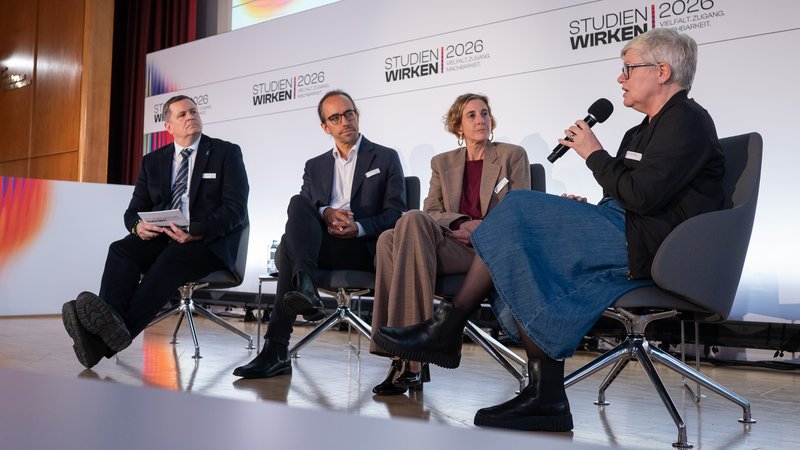
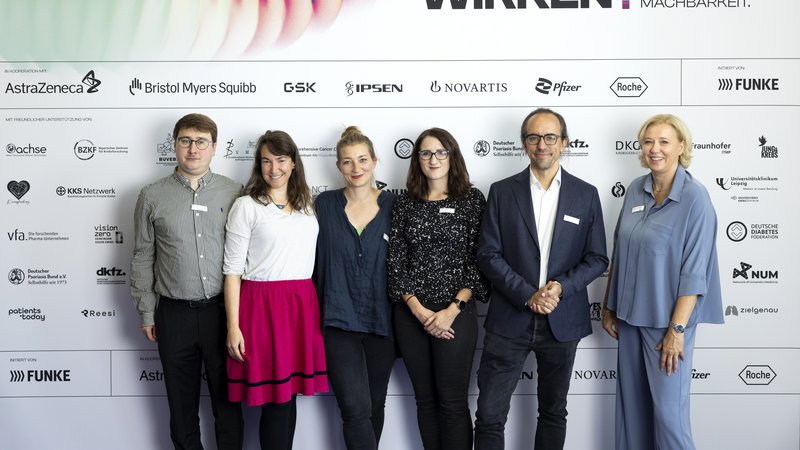
Berlin, 15 October 2026. Around 300 guests from the worlds of politics, academia, clinical research, healthcare, industry and patient organisations gathered at the Auditorium Friedrichstraße for the event ‘STUDIEN WIRKEN 2026: Diversity. Access. Feasibility.’ The focus was on how clinical trials can become better known and how more people can gain access to them. The Network of University Medicine (NUM) is a scientific partner of the STUDIEN WIRKEN initiative.
Without people taking part in clinical trials, medical progress would grind to a halt. This is the only way to test whether new medicines and therapies actually help, and the only way they reach those affected. This is precisely where the initiative comes in.
Access to new treatments
The event began with two personal stories. Marlene Assmann-Khoueiry explained: “The fact that I can tell my story today is thanks to a clinical trial.” In her own words, without this trial she would probably have died in spring 2019. Georgina Hoffmann, who was diagnosed with Lynch syndrome (a hereditary predisposition to certain cancers), is now active as a patient advocate. She said: “I have seen first-hand how a trial can change a life.”
Gender equality in research
The discussion on gender equality highlighted just how unevenly the opportunities to take part in trials are distributed. Prof. Dr Alena Buyx, Professor of Ethics in Medicine and Health Technologies at the Technical University of Munich, put the proportion of men in medical research at between 75 and 90 per cent. Esther Schweins spoke of women’s health being a “rare form of health”. The actress and director co-hosts the podcast “Unglaublich krank – Patienten ohne Diagnose” (Incredibly ill – patients without a diagnosis) with the doctor Martin Mücke, which focuses on rare diseases.
Federal Minister for Research Dorothee Bär emphasised: “We need more women in clinical trials. Only when we reach 50 per cent here can we say that trials are effective.” In her opening speech, she also explained that doctors still rely on findings that were predominantly gathered from men. This could lead to certain conditions in women being detected too late.
Recruiting trial participants: recommendations as a medical service?
Another key focus was the question of how to encourage more people to take part in trials. Thomas Roth summed it up: “No one is looking for a trial; patients are looking for a solution.”
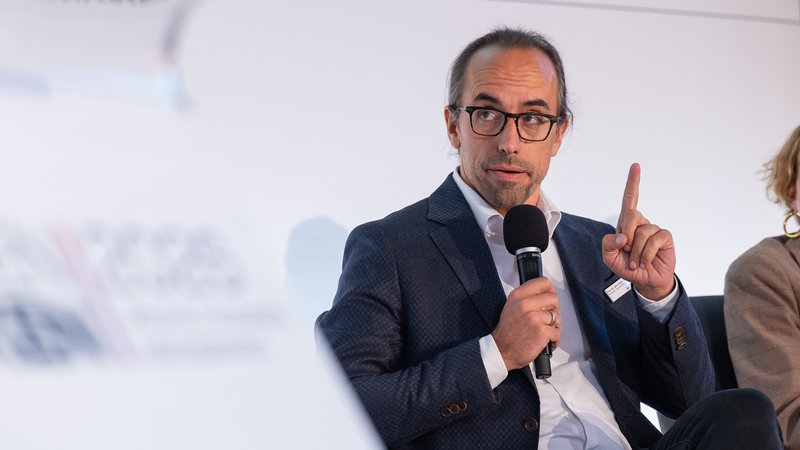
Prof. Dr Jörg Janne Vehreschild, spokesperson for the NUM Study Network and a member of the STUDIEN WIRKEN Advisory Board, suggested that recommendations to take part in studies should in future be regarded as a medical service. Nina Lammers made it clear: “Clinical trials have nothing to do with belief. Clinical trials are scientific evidence.”
Strengthening Germany as a clinical trial location
A panel discussion focused on strengthening Germany as a location for clinical trials. For a long time, Germany ranked second worldwide in terms of the number of clinical trials; it has since fallen behind. The Federal Government’s Medical Research Act is intended to provide impetus for improvement. The question was raised as to whether this would be sufficient and what additional steps could help Germany make progress in the international competition for clinical trials.
The programme comprised over 20 individual sessions, including panel discussions, specialist presentations and workshops, as well as a ‘Study Slam’ and a networking evening.
About STUDIEN WIRKEN
The initiative aims to make clinical research more accessible and to dispel reservations. Publisher Julia Becker, Chair of the Supervisory Board of the FUNKE Media Group, said in her welcome address: “Medical progress begins with research – but its impact only becomes apparent when it reaches people.” Henriette Schnabl, Head of STUDIEN WIRKEN, summarised the initiative’s aim: “Clinical trials save lives – but too few people realise this, and even fewer dare to take part themselves.”
Further information: visit the STUDIEN WIRKEN website