


Today, 27 May, is the European Day of Emergency Medicine - introduced to raise public awareness of the relevance of emergency care in Europe, to inform people about first aid measures and to recognise and appreciate the work of rescue services and Emergency Departments.
We would like to take this opportunity to introduce AKTIN, the NUM Platform for Acute, Intensive and Emergency Medicine.
AKTIN pursues two main goals:
💡 All care data from the Emergency Departments and Intensive Care Units of academic medical centres, other hospitals and, in perspective, the entire rescue chain should be available more quickly for research and reporting, usually on a daily basis.
The quality of care in Emergency Departments and in acute and emergency medicine is to be improved - through new standards in documentation, for example, and by using the combined experience of German university medicine to optimise and accelerate treatment processes ("benchmarking").
And how do patients benefit from this?
- Better care on site: In emergencies, every minute counts. Fast and targeted action can be crucial for the patient's further progress and recovery.
→ By creating the conditions for establishing more efficient, better-coordinated processes, AKTIN helps more patients receive the right treatment faster. - Faster response in a crisis: The COVID-19 pandemic has shown how important it is not to lose track of the spread of pathogens and the current capacity of the healthcare system, especially when many people are ill at the same time.
→ AKTIN has been providing the Robert Koch-Institute (RKI) and the Federal Ministry of Health (BMG) with up-to-date data on patient numbers, symptoms, diagnoses, length of stay and emergency department capacity utilisation on a daily basis since 2020. - Safe research: Which therapy is right for whom in which situation? What risks need to be weighed up? No medical progress is possible without research.
→ AKTIN provides researchers and public health institutions with daily access to nationwide and standardised data on acute, emergency and intensive care medicine.
The special feature:
The network is organised decentrally. This means that the data remains in the respective clinic and under its control. Data is only analysed in a secure environment, i.e. 100% in compliance with data protection regulations, following independent review and approval for a specific purpose.
AKTIN in figures
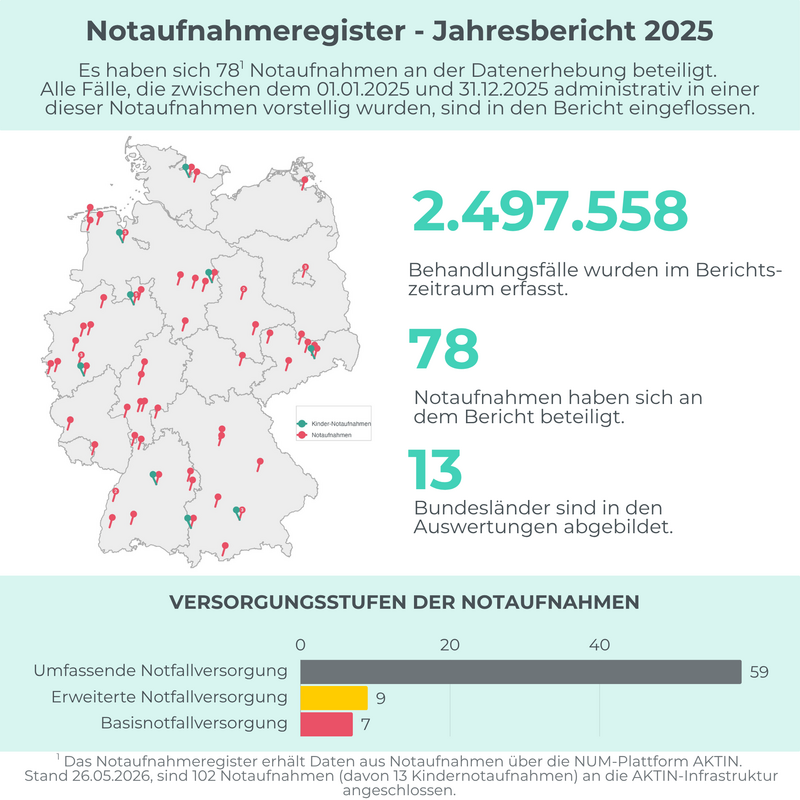
- 2,497,558 new cases were included in 2025
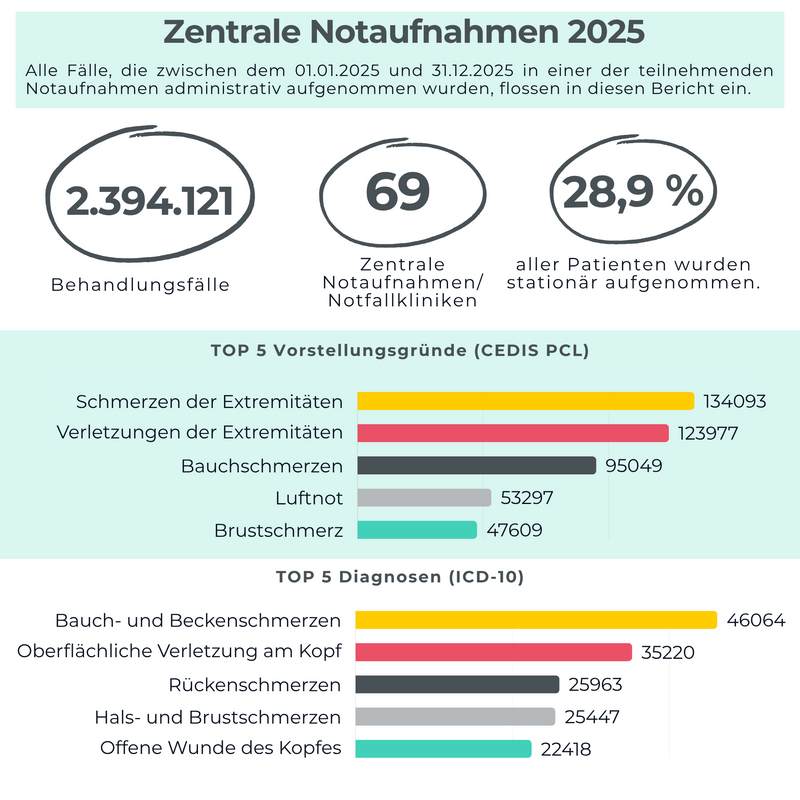
- 2,394,121 cases were registered in the 69 centralised Emergency Departments. Of these, 28.9 % of patients were admitted as inpatients. The most common reason for presentation? Pain in the extremities.
- 103,437 cases were registered in the 9 paediatric emergency departments. Of these, 22.8% of all patients were admitted as inpatients. The most common reason for presentation? Fever.
→ Further information can be found in the illustrations.
- 102 Emergency Departments are connected to the AKTIN infrastructure, 78 provide data for research purposes
- 42 peer review publications have already beenpublished on the platform
In short: AKTIN ensures that doctors can make the best decisions faster in an emergency - and that patients receive better, safer and more effective treatment.
More information about AKTIN: