
Quality assurance
In cooperation with the BioMaterialBank Heidelberg (BMBH), the Integrated Biobank Jena (IBBJ) and the BioBank Dresden (BBD), GBN regularly carries out proficiency tests with partner biobanks. Both tissue and liquid biosamples are analysed. The biobanks use proficiency tests to check sample quality and thus their processes – from sample receipt and storage through to derivative preparation and measurement.

Interlaboratory tests
with different sample types

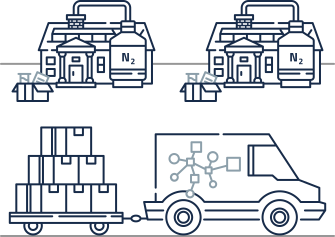
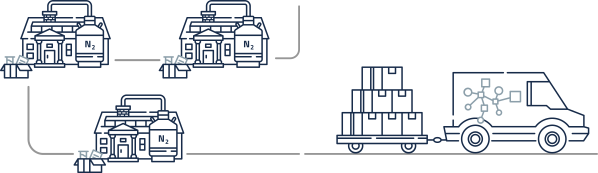
Step 1: Preparation and dispatch
The organisers send biosamples to all participating
biobanks of the German Biobank Network (GBN).

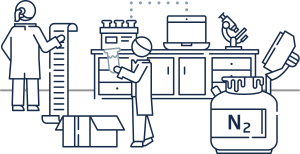
Step 2: Processing
The biobanks process the samples according to their procedural instructions and in accordance with the specifications in the EQA scheme.
Step 3: Packaging and return shipment
They then return the samples as specified.


Step 4: Analysis
The organisers check the samples and evaluate the associated data.
Step 5: Feedback
They discuss the results individually with the biobanks and suggest improvements.

Tissue proficiency tests
In order to minimise or ideally eliminate the influence of pre-analytical processes on the quality of human tissue samples, GBN established tissue proficiency tests for GBN biobanks in 2017 in close collaboration with the Heidelberg site. Participation has a modular structure so that biobanks can select the modules that are relevant to their individual processes and quality objectives. The modules including evaluated processes/parameters at a glance:
- Cryogenic tissue: cutting, cryopreservation, sectioning, H&E staining, RNA extraction, quality control
- FFPE tissue: cutting, sectioning, H&E staining, suitability of the material for IHC, immunofluorescence and spatial analysis
- Pathological-anatomical assessment: assessment of various parameters, e.g. tumour content
- Virtual microscopy: scan sharpness
Once participation has been completed and all results analysed, the biobanks receive a comprehensive, detailed report. In addition, there is the opportunity to discuss the results in a personal feedback meeting and develop specific improvement measures.
The tissue proficiency test provides biobanks with long-term support in quality assurance, strengthens the reproducibility of research results and contributes to the harmonisation of the relevant processes. For example, the RNA yield from cryogenic tissue has already been increased across all sites. Biobanks that want to systematically review and further develop their quality standards benefit greatly from participating.
Proficiency tests for liquid biological samples
The proficiency test for liquid biological samples was developed by the Integrated Biobank Jena in collaboration with the German Biobank Network (GBN) and established here as part of the GBN quality programme. The aim is to ensure the long-term quality of liquid biological samples and to reduce the impact of pre-analytical process deviations. The proficiency tests cover key stages from sample receipt and processing through to storage, documentation and dispatch under real-world conditions.
Participation is organised on a modular basis. Biobanks can therefore specifically assess those modules that are relevant to their respective processes and quality objectives.
An overview of the modules currently on offer, including the assessed processes and parameters (as of 2026):
- Homogeneity of plasma aliquots: Assessment of centrifugation and aliquoting based on platelet count
- Volume accuracy: Verification of the precision and accuracy of manually or automatically aliquoted sample volumes
- Incoming inspection and documentation: Detection and traceable recording of pre-analytical deviations during sample receipt
- Dispatch and packaging: Assessment of dispatch documentation and the packaging of potentially infectious samples in accordance with UN3373 and ADR/IATA P650/PI650
- Temperature monitoring: Monitoring of temperature conditions during transport on dry ice
- Contamination analysis: Detection of possible chemical contaminants in plasma aliquots using NMR spectroscopy (in collaboration with the Institute for Clinical Chemistry and Laboratory Medicine in Dresden – Dr Alexander Funk, Funk Labs)
- Accompanying questionnaires: Recording of site-specific processes and framework conditions to enable a well-founded interpretation of the results
Once the proficiency test has been completed, the participating biobanks receive an individual and detailed results report, as well as a certificate of participation. In addition, where required, the results are discussed in a face-to-face feedback session, potential causes of deviations are analysed, and specific measures for improvement are identified. Repeated participation allows developments to be tracked over a longer period and progress in process quality to be demonstrated.
The proficiency tests support biobanks in the systematic review and further development of their quality standards. They help to harmonise processes across sites, increase the comparability of biosamples and strengthen the reproducibility of multicentre research results.
As part of the Biobank Platform for Germany (BPD), proficiency tests for liquid biological samples are offered to all sites within the Network of University Medicine (NUM). The proficiency testing programme is therefore an essential component of the joint quality assurance structures within the BPD.
In addition, international proficiency tests are offered by the Institute of Clinical Chemistry and Laboratory Diagnostics at Jena University Hospital in collaboration with the GBN. In this way, the established quality assurance framework is also made available to biobanks outside the BPD as well as to international biobanks, thereby promoting interoperability within a European context through the standardisation of biobank processes.
PBMC proficiency test
Peripheral blood mononuclear cells (PBMCs) have also become increasingly relevant for biobanks as a result of the coronavirus pandemic. In order to assess the viability and functionality of PBMCs, GBN organised a proficiency test for 12 biobanks in 2020 in collaboration with the Integrated Biobank of Luxembourg (IBBL). GBN defined the workflow in cooperation with BioBank Dresden (BBD). The results help to improve processes.
Overview of GBN biobanks with information on participation in proficiency tests