
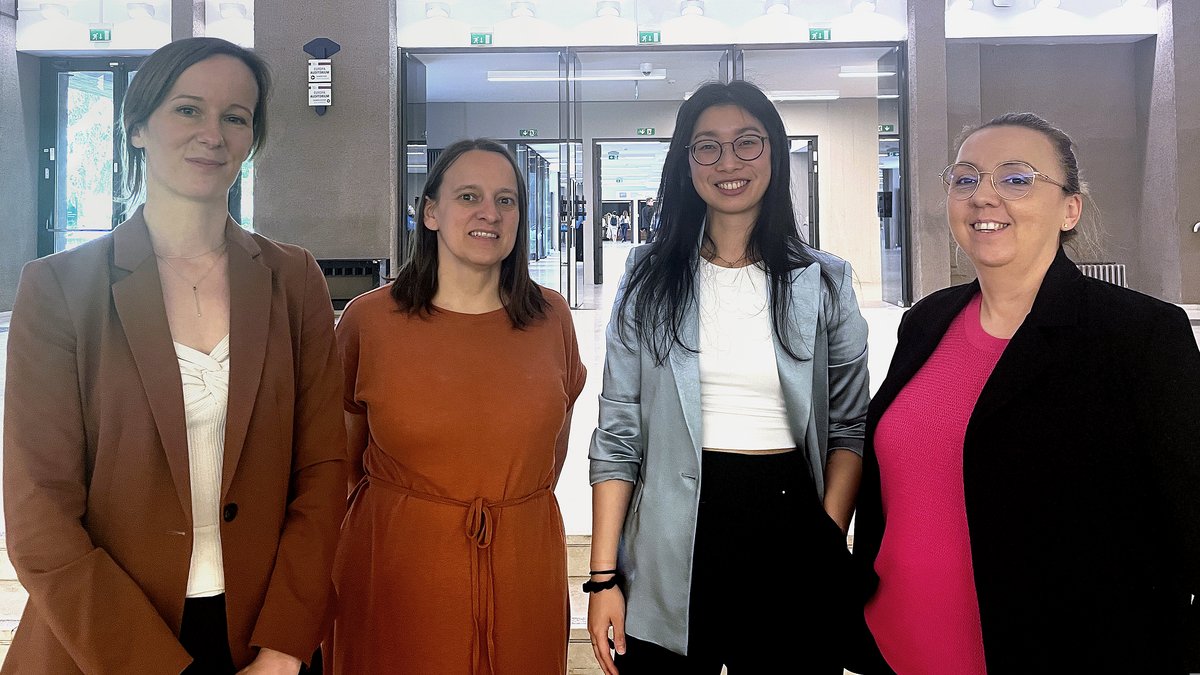
On the occasion of International Women’s Day, Nhu Tuyen Phan (Germany), Joséphine Uldry (Switzerland), Agnieszka Matera-Witkiewicz (Poland) and Mieke De Wilde (Belgium) – the four Quality Management leads who jointly developed the Quality Handbook for Biobanks (QHB) – spoke about their shared journey. What began as an idea in 2023 became a European reference framework built entirely on collaboration and in-kind commitment.
When you look back to October 2023: What made you say “yes” to this initiative?
Nhu Tuyen Phan: The planning had actually started much earlier. All of us had national QM manuals, and I could see the potential to harmonise these approaches and connect our expertise. The idea of creating something with tangible impact for the entire biobanking community was incredibly motivating.
Joséphine Uldry: For me, it was the opportunity to learn from peers across Europe who are highly advanced in quality management. It was a chance to grow together.
Mieke De Wilde: I had already worked with the German, Swiss and Polish manuals while developing the Belgian one. So when Tuyen contacted us, I was excited. Instead of just comparing documents, we could truly align and build something harmonised.
Agnieszka Matera-Witkiewicz: Collaboration is at the heart of scientific development. This handbook is a tool to strengthen quality and improve research in a very practical way. Being part of something that can create real impact beyond national borders was my strongest reason to say yes.
The QHB was developed entirely through in-kind contributions, alongside your regular responsibilities. What did that mean in practice?
Agnieszka Matera-Witkiewicz: It meant a great deal of personal commitment. We had to carefully reorganise our schedules and invest significant personal time. But responsibilities were clearly divided, and that made the cooperation effective.
Mieke De Wilde: It was a lot of work, and I’m grateful for the support of my National Node Director, who allowed me to carve out time for it. At the same time, it was extremely rewarding. We went deep into the details of the standard and its implementation. I learned so much from this process. And I think it’s also fair to say that the project benefited strongly from Tuyen’s very thoughtful coordination, which helped keep everything on track.
Nhu Tuyen Phan: It required not only organisation, but flexibility. We scheduled regular and additional meetings, especially towards the end. Looking back, I feel a strong sense of pride – the QHB is really our “baby.” It reflects two and a half years of shared expertise and commitment.
You come from four different countries and regulatory contexts. What were the biggest challenges – and advantages – of working across borders?
Agnieszka Matera-Witkiewicz: Regulatory differences were not the biggest challenge because we agreed from the beginning that the handbook should be internationally applicable and not country-specific. For me personally, as the only one managing an accredited biobank, I felt a particular responsibility to ensure the handbook would truly work in a real accredited environment.
Joséphine Uldry: The real challenge was going line by line and agreeing on every word. It required consistency over a long period. But in the end, building a shared vision across borders brings much more value than working nationally alone.
Nhu Tuyen Phan: Aligning terminology at the beginning was important. We had to make sure we were truly speaking the same language. But working across borders allowed us to combine best practices from each country. The result is stronger than what any of us could have achieved individually.
What made your collaboration work so well?
Joséphine Uldry: It was like running two marathons – first writing the handbook, then going through the intense review phase. I don’t think I would have had the courage to move that fast without the team. That team spirit was essential.
Mieke De Wilde: We truly had a good time doing this. It was demanding, but it was also fun.
On International Women’s Day, we would like to end on a personal note: What is the biggest lesson you take away from contributing to this European initiative?
Agnieszka Matera-Witkiewicz: For me, the biggest lesson is that women truly have a superpower. There is nothing more powerful than a woman who believes in herself. Working with such strong, self-confident women and a shared vision was an extraordinary experience.
Joséphine Uldry: I learned the importance of being realistic and simply doing the work step by step. And I deeply admired the different strengths and soft skills each of my colleagues brought to the table.
Nhu Tuyen Phan: For me, this project shows what can be achieved through collaboration and mutual support. International Women’s Day is a wonderful opportunity to celebrate women’s achievements and I’m proud of what we created together. At the same time, I would also like to acknowledge the many colleagues, women and men alike, who contributed as reviewers. It was truly a collective European effort.
Mieke De Wilde: We just happened to be four women and that feels completely natural. The fact that it feels normal is actually something special. I’m grateful to work in a context where this is simply how things are.