

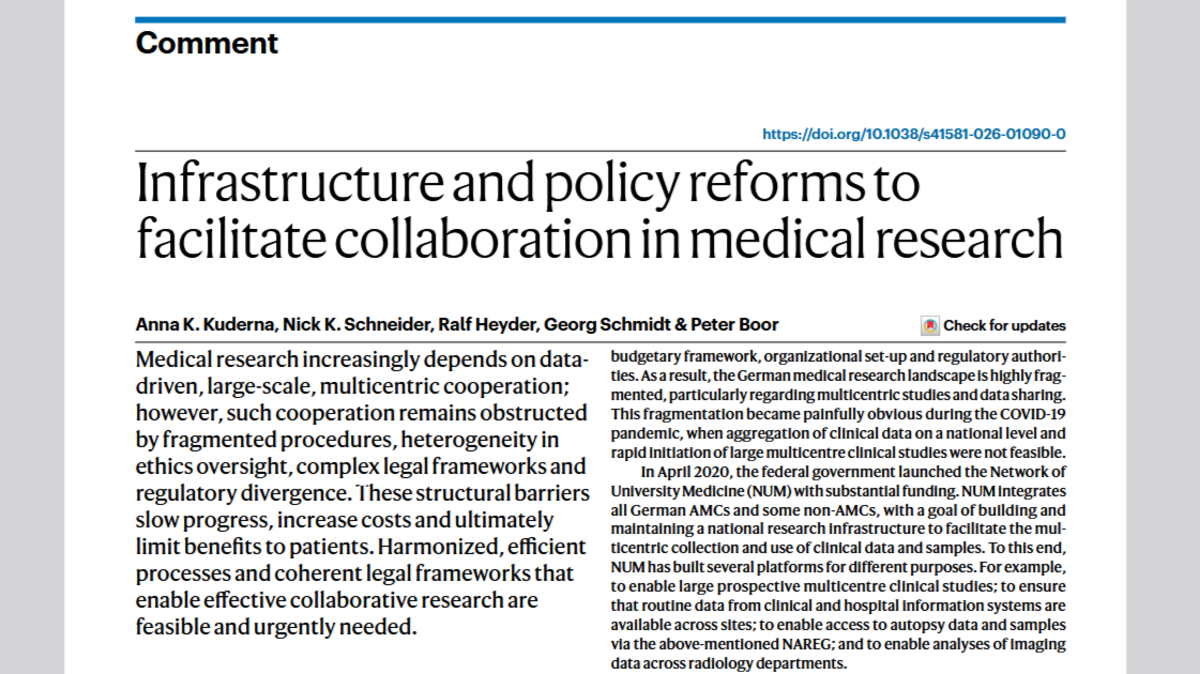
Today, international medical research relies more than ever on the exchange of large volumes of data and collaboration across multiple sites. A recent comment in Nature Reviews Nephrology highlights the infrastructure and policy reforms needed to make this collaboration more efficient.
Drawing on developments in Germany, the authors describe how the Network University Medicine (NUM), the National Autopsy Registry (NAREG), optimized ethical review processes (one study, one vote) and digital platforms have created key conditions for modern, data-driven research. The aim should be to remove administrative barriers, make research data more accessible and implement multicenter studies more quickly. At the same time, it is clear that national measures will need to be supplemented in future by international and European regulations – such as those required for the European Health Data Space – in order to strengthen medical research in Germany in the long term.
The article underscores the importance of high-performance research infrastructures and harmonised framework conditions for the medicine of the future – whilst also highlighting the role of the National Autopsy Registry as part of this development.
The full comment by Kuderna et al. can be read here.