

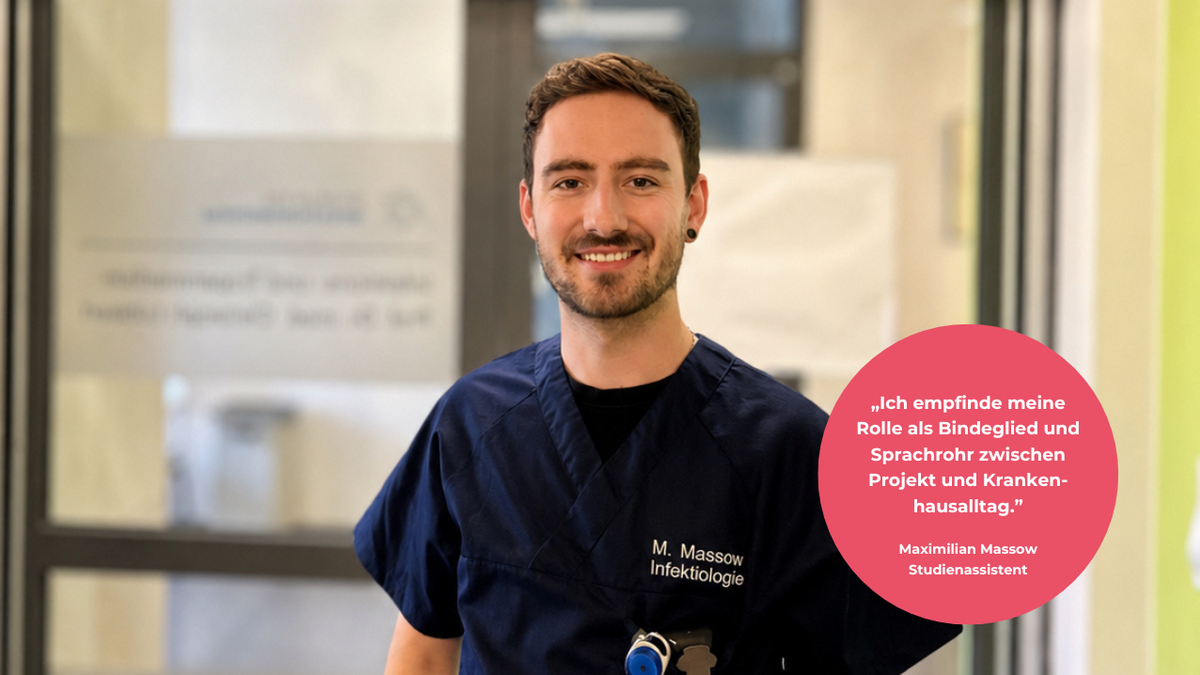
Maximilian Massow, study assistant in infectiology and tropical medicine at Leipzig University Hospital
How did you become a study assistant?
In my previous career as a surgical assistant, I had occasional contact with research projects in general and visceral surgery and in the burns centre, where intraoperative samples were taken. It was then that I first came to terms with what it means to do research and the scope and relevance of research as a whole. Ultimately, I was inspired by my sister, who started as a study coordinator in another project shortly before me, and applied to work in infectiology and tropical medicine at Leipzig University Hospital. I've been working there as a study assistant since January 2025.
What does your day-to-day work look like?
Over the last few months, I've worked out a clear schedule for my day-to-day work. First, I get a list of patients who have already been pre-screened. Then I see how many of them are eligible for the study. Then I plan my next steps individually. I pay attention to what's going on in the clinic at the time - for example, ward rounds, examinations or treatments. This allows me to find the right time to talk to the treating doctors, nursing staff and patients. In addition to study inclusions, potential final visits and sample collections are also part of my daily work. In the last third of the day, I focus on documentation in the Electronic Case Report Forms (eCRF). These are digital forms for the standardised recording of patient data in clinical trials.
What role does your work play in the success of the trials at NUM?
I believe that the crucial points in such projects are communication and interdisciplinary collaboration, as well as a certain instinct for making initial contact with colleagues and patients. I see my role as a link and sounding board between the project and everyday hospital life and try to harmonise the two in the best possible way. My advantage is that, thanks to my nursing background, I know the perspective from a clinical point of view and know what I would have wanted from study assistants back then if they approached me with a concern.
What motivates you personally most about your job?
What motivates me most is constantly facing new challenges and providing the best possible support for future research questions as a study assistant. Apart from that, I also enjoy the patient contact and it makes me very happy when patients feel better through a short conversation and I can thus make a small contribution to their well-being.