
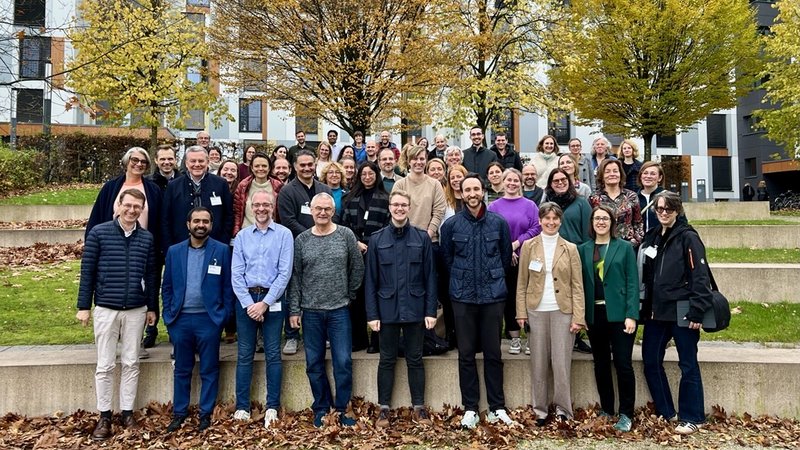
Around 60 members of the German Biobank Network (GBN) met in Bielefeld on 4 and 5 November 2025. The meeting was hosted by Biobank OWL and chaired by GBN board member Dr Gabriele Anton. "The community meeting offers an ideal platform for networking activities, discussing current developments and jointly setting standards for the future of biobanking in Germany," emphasised Anton.
Biobank OWL: focus on local research
Dr Gabriele Anton and Prof Dr Thorsten Kaiser (University Hospital OWL) kicked off the event with a presentation on Biobank OWL. The facility was established during the coronavirus pandemic and now has two locations - at Bielefeld University and Lippe University Hospital. "The biobank is the basis for high-quality research, especially if we want to effectively develop future areas such as data-driven medicine and AI-based decision support," said Kaiser.
A key project supported by the biobank is the paediatric health study "Kleine Eulen OWL" (Little Owls OWL), which investigates the development of the child's microbiome. Not only human samples are collected here, but also environmental samples such as house dust and tap water.
GBN community in action
The strength of the network was particularly evident in the example of the PEDNET-LC study on post-acute infection syndromes in children and adolescents, presented by Prof Dr Alexandra Nieters (FREEZE-Biobank Freiburg). She described how the community reviewed SOPs at short notice, advised on unknown sample types and clarified key questions. "The project is a living community," emphasised Nieters, "because we share our knowledge and thus make a direct contribution to complex, supra-regional research projects."
Working groups: Methods, data and quality
The GBN working groups presented their progress and future goals. The collection evaluation working group, presented by Dr Daniel Brucker (Interdisciplinary Biomaterial and Database Frankfurt), is developing a decision tree to support biobanks in systematically evaluating existing and external collections. It will be supplemented by a handout and a planned publication. The first results are expected next year.
Dr Philipp Schöppner (Comprehensive BioBank Marburg) presented the work of the PBMC working group, which is investigating the question of whether frozen PBMCs are "fit for purpose". The group has developed its own quality score based on a literature review and the determination of pre-analytical influencing factors. The focus is now on consolidating the findings into practical recommendations for the community.
With regard to data processes, Julian Dörenberg (Core Facility Biobank - "The Bänk", Tübingen) presented the activities of the data quality working group. As there is currently no external quality control in the data area, the working group is planning the first GBN data ring test, accompanied by a survey on data import channels and data set structures. The aim is to integrate this into the GBN quality programme in order to establish external quality control of data nationally.
Quality management: standards for the entire network
The overarching GBN quality programme, presented by Nhutuyen Nguyen, GBN Coordinator for Quality Management, was another focus of the meeting. Germany leads the international list of countries with the most biobanks that already carry a BBMRI-ERIC Quality Label. It is expected that 15 GBN biobanks will be labelled by 2027.
A key instrument for further harmonisation is the Quality Handbook for Biobanks, developed jointly with BBMRI colleagues from Belgium, Switzerland and Poland, which serves as a guide for implementing and improving the quality management system (QMS) of biobanks and will be available as an open access publication. At the same time, the ISO20387 working group is developing proposals for the systematic revision of the international biobanking standard.
"A biobank platform for Germany": setting the strategic course
Dr Gabriele Anton presented a strategically important topic with the initiative "A biobank platform for Germany". The project is anchored in the federal government's coalition agreement and is part of the high-tech agenda of the Federal Ministry of Research, Technology and Space (BMFTR). The aim is to create a central digital platform that makes samples and data visible nationwide and coordinates research enquiries. The concept is supported by a broad alliance of science, industry and associations. This will create a nationwide networked infrastructure that will benefit research, industry and patients alike.
Feedback from the community
The meeting in Bielefeld received extremely positive feedback, particularly from new network members. Dr Alessandro Grodziecki (BioMaterialBank Heidelberg) emphasised that the meeting was "a great enrichment", above all because of the "impressively supportive attitude of the community". The exchange was also valuable for Dr Lena Riesenegger from the Central Biobank Ulm (CBBU), which is still under construction: "The direct contact with other locations that are structured similarly to us has helped us enormously."
Conclusion: impetus for the future
"The meeting showed once again how important joint action is for the future of biobanking. The contributions from research, practice and quality management underline how diverse and future-oriented the work of the GBN is," summarised GBN Board Spokesperson PD Dr Sara Nußbeck.
The next community meeting will take place on 23 and 24 April 2026 - as a guest of the Integrated Biobank Mannheim (IBM).