
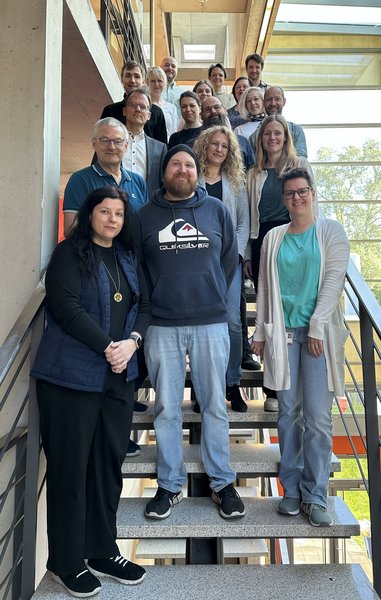
How can biological samples and the associated data be described in a standardised manner across different sites and made accessible for research? How can existing standards be further developed so that they are also practicable in the day-to-day operations of biobanks? These questions were the focus of the workshop ‘MII CDS Biobanks and future integration into biobanks, DIC, GBN and BBMRI-ERIC’, which took place on 23 April 2026 in Mannheim. The event was organised and chaired by Patrick Skowronek (Heidelberg University’s Mannheim Medical Faculty and the German Cancer Research Centre, DKFZ, Heidelberg).
The focus was on the Medical Informatics Initiative’s (MII) Core Data Set (CDS) for biobanks, its further development for the 2026 version, and the requirements for future integration into biobanks, Data Integration Centres (DIC), the German Biobank Network (GBN) and the European biobank network BBMRI-ERIC. A total of 21 people from 15 GBN sites took part. The workshop was explicitly not designed as a purely IT-focused event – the experiences and requirements of other biobank staff were also to be incorporated into the discussion.
To kick off the event, Prof. Dr Martin Lablans (DKFZ Heidelberg) presented use cases in Germany and Europe; Dr Cecilia Engels (German Consortium for Translational Cancer Research, DKTK) provided an insight into the further development of the MIABIS standard (Minimum Information About Biobank Data Sharing) in version 3.0; and Noemi Deppenwise (Friedrich-Alexander University, Erlangen-Nuremberg) presented version 2026 of the MII CDS biobanks.
MII CDS and MIABIS
The MII CDS Biobanks was originally based on MIABIS. Both data sets are compatible, although the MII CDS goes into greater depth and, in particular, enables a detailed mapping of biosamples and their context. Among other things, the dataset supports key use cases such as cross-site sample searches, the export of sample data and the comprehensive description of biological samples. A key focus of the current development work is the standardisation of the sample hierarchy, which is intended to enable a harmonised representation of samples across different MII and DIC sites.
Practical requirements
In the practical session, participants worked on specific issues in three working groups. The first group addressed biosample certificates, sample reports and accompanying documents. Among other things, the discussion centred on which content can already be captured using the MII CDS and which additional data elements would be required for a standardised sample certificate. The desire for a uniform format became clear during these discussions. The question of the available options – ranging from Excel lists to structured formats such as XML or JSON – was also discussed.
The second working group focused on diagnoses, clinical presentations and sample-associated data. A key challenge here is the meaningful linking of diagnoses to samples. For certain queries, a link via the respective case or an ‘episode of care’ might be more appropriate than a direct association with the sample. At the same time, such an association is often difficult to reconstruct from clinical documentation.
The third working group focused on sample search, logic and hierarchy, as well as the completeness of the available information. Discussions centred on which samples researchers specifically require and which data elements are necessary for this. It also became apparent that usage processes in the biosample environment cannot yet be fully automated.
The detailed findings of the working groups and the resulting requirements for the further development of the MII CDS Biobanks are to be presented and discussed in greater depth in a webinar. The date for this will be announced in due course.